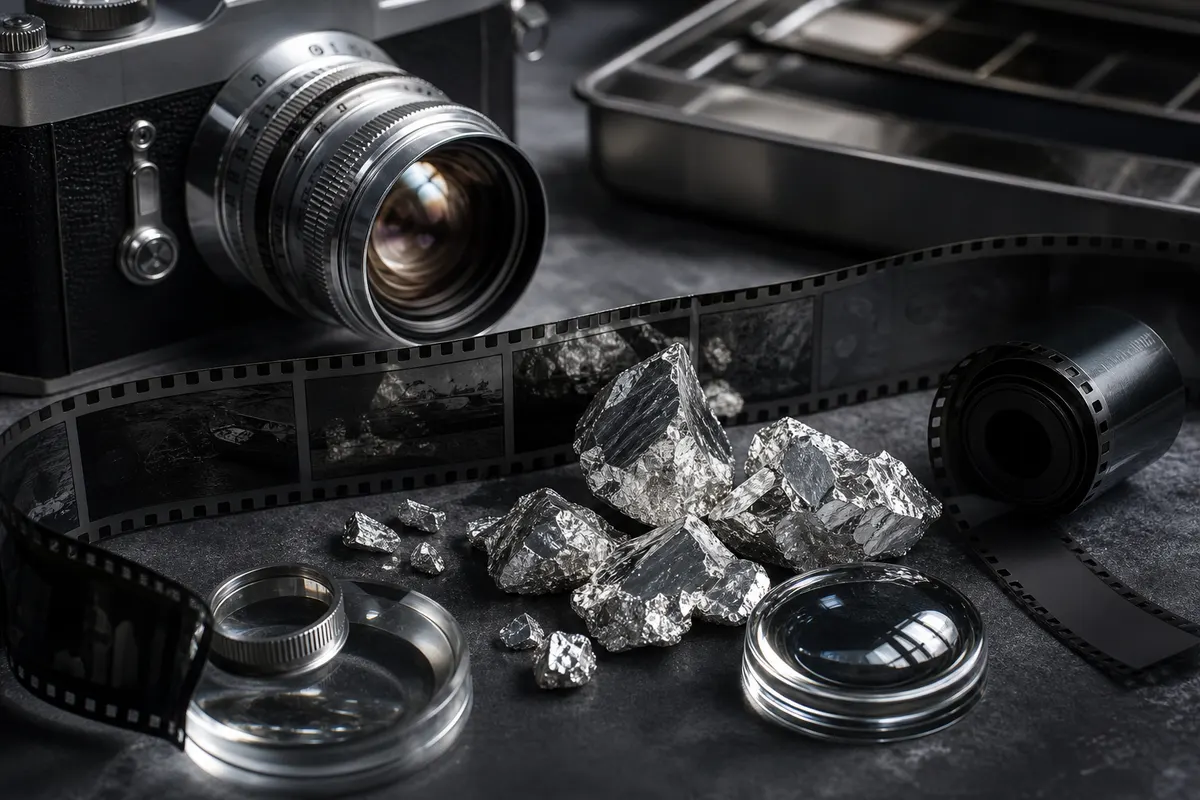
Silver in photography and optics share a deep historical bond. Analog photography was built on light-sensitive silver compounds (silver halide) — every film frame contained millions of silver crystals. As photography went digital, film silver use declined, but in precision optics — telescope mirrors, lens coatings, filters, and sensors — silver remains irreplaceable. Silver's unmatched reflectivity in visible and near-infrared makes it the first choice for space telescopes and observatories.
Analog photography and silver halide
Photographic film uses a gelatin emulsion with silver halide crystals (AgBr, AgCl, AgI). When a photon hits a crystal, silver ion becomes metallic silver and forms a latent image. In development, sensitized crystals become metallic silver and the image becomes visible. Each 35mm frame used about 0.05 to 0.1 g of silver.
At the peak of analog photography (1990s), the industry consumed 30%+ of global silver. Digital cameras reduced this to under 1%. Analog photography continues among artists and enthusiasts; Kodak and Ilford films are still produced.
Optical mirrors and telescopes
Reflecting telescopes — from home Newtonians to Hubble and James Webb — use silver mirrors. Silver has 97–99% visible reflectivity; aluminum 85–90%. For astronomy collecting faint light over hours, every percent of reflectivity matters.
Hubble has a 2.4 m mirror with 100 nm silver coating. James Webb has gold mirrors (for infrared) but secondary mirrors and other optics use silver. Ground observatories also have multi-meter silver mirrors.
Lens and filter coatings
Camera and telescope lenses are often coated with thin metal layers (silver, aluminum, or dielectric) to reduce internal reflection and increase light transmission. Silver coating is used in some optical filters and infrared lenses. Multilayer designs with silver and dielectrics enable advanced spectral performance.
Image sensors and digital optics
Although CMOS and CCD sensors are silicon-based, camera optical elements — mirrors, prisms, filters — may have silver coating. In infrared photography and spectroscopy, silver mirrors and filters separate wavelengths. In lasers and quantum optics, silver mirrors guide beams with minimal loss.
Optical coating process
Silver coating on optical mirrors uses vacuum evaporation or sputtering. Layer thickness is precisely controlled — usually λ/4 for anti-reflection at design wavelength. 999.9 or higher purity prevents scatter and impurity absorption. After deposition, a protective SiO2 layer prevents oxidation and tarnish.
Bazaarnoghre supplies high-purity 999.9 silver for optics and plating.
| Application | Silver form | Thickness/amount | Status |
|---|---|---|---|
| Photographic film | Silver halide (AgBr) | ~0.05 g/frame | Declining |
| Telescope mirror | Metallic silver layer | 100–200 nm | Active |
| Lens coating | Thin silver layer | 50–150 nm | Active |
| Optical filter | Silver / dielectric | Variable | Active |
| Photo paper | Metallic silver | ~0.1 g/sheet | Niche |
Silver recycling from film and photo paper
Photo labs and film plants recover silver from developed film and fixer effluent via electrolytic recovery from thiosulfate solution. As analog declines, this source shrinks but remains active.
Art photography and analog market
Analog photography has renaissance among art photographers. Kodak Portra, Ilford HP5, and Fuji Acros are still made. Each 36-exposure roll uses about 2–4 g of silver. Active labs recover silver from film and paper. This niche but stable market maintains demand for silver nitrate and processing chemicals.
Gelatin silver black-and-white prints remain valued in galleries and museums. Professional printers use pure silver for developer and toning solutions.
Next-generation telescopes
Extremely Large Telescope (ELT) with a 39 m mirror is under construction. Mirror segments are silver-plated. NASA's Roman telescope and future missions still depend on silver optics. Each new space mission creates specialized demand for highest-purity silver.
For mirror making, read ../silver-mirror-manufacturing/. Products ../../../index.html#products, inquiry ../../../index.html#contact, articles ../.
Guide to silver supply for photography and optics
Bazaarnoghre supplies 999.9 with certificates and long-term contracts. ../../../index.html#products, ../../../index.html#contact, ../.
Industrial FAQ about 999.9 silver
Ingot vs granule? 999.9 vs 999? ../../../index.html#products.
Conclusion
Silver in photography evolved from the main film material to a specialized optics element. Digital reduced film use but telescope mirrors, lens coatings, and precision optics still depend on silver's unmatched reflectivity. 999.9 silver quality determines optical performance.
Further reading
Related articles
To view 999.9 fine silver products, visit the Bazaarnoghre products page.