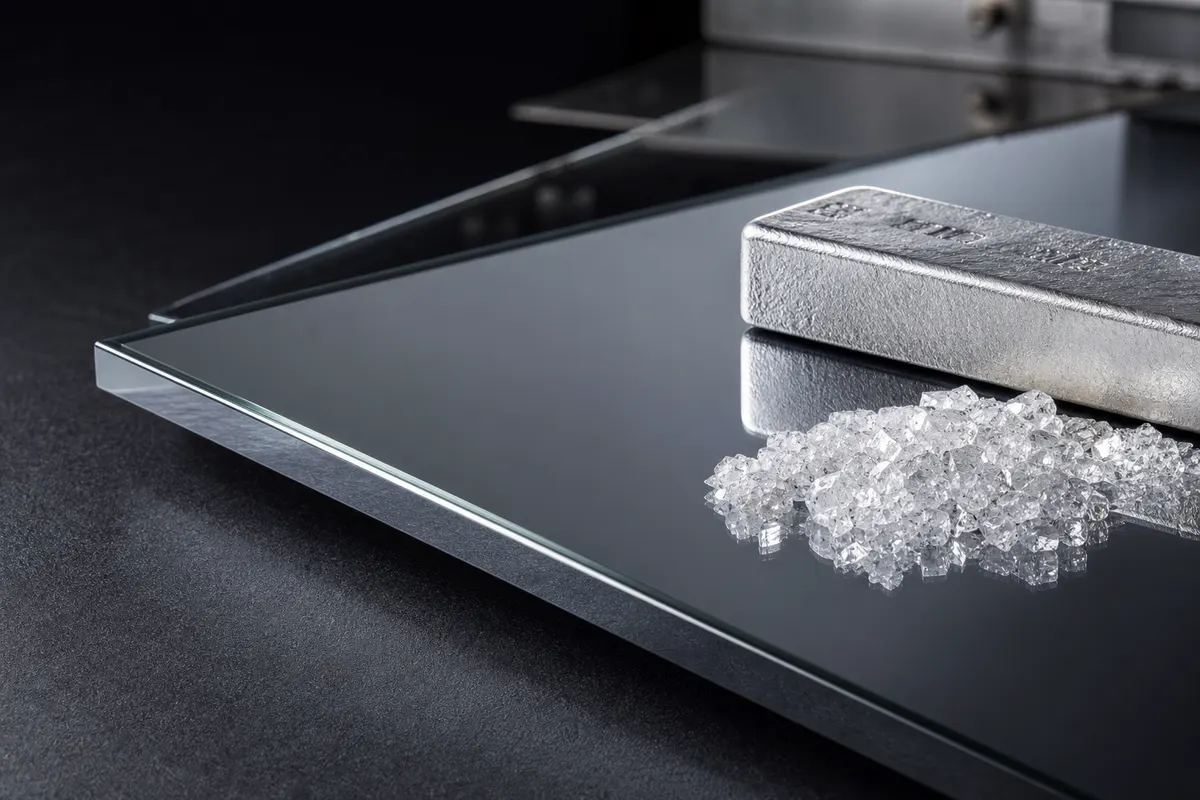
Silver mirror manufacturing is one of the oldest and most enduring industrial uses of silver. Modern mirrors — from bathroom and interior decor to telescope and laser mirrors — are coated with a thin silver layer. Silver has the highest reflectivity in the visible spectrum (95–99%) among metals and outperforms the more common aluminum substitute in precision applications. For mirror manufacturers, access to consistent-quality 999.9 silver is a critical raw material.
History and importance of silver in mirror making
Before the 19th century, European mirrors used a silver-mercury layer (verre églomisé). The Brønsted process replaced it in 1835: reducing silver from silver nitrate solution with sugar or formaldehyde on glass. This method remains the foundation of mirror manufacturing today. Aluminum, introduced in the 1930s as a cheaper alternative, has lower reflectivity (85–90%) but silver remains the gold standard for precision optics — telescopes, lasers, interferometers, and industrial mirrors. Silver reflects best at 450–900 nm wavelengths.
The global mirror market exceeds $20 billion annually. Silver use in mirror making is about 30–40 million ounces per year — one of the most stable industrial consumption segments.
Silver mirror production process
Production includes: glass preparation (washing, degreasing, alkali surface activation), sensitizing with stannous chloride (SnCl2) as catalyst, silver plating with silver-ammonia solution and reducer (dextrose or formaldehyde), and protecting the silver layer with lacquer, paint, or copper. Silver layer thickness is typically 100–150 nm — about 0.7 to 1 gram of silver per square meter.
Glass quality, nitrate purity, and precise temperature and pH control affect uniformity and final reflectivity. Impurities in silver nitrate can cause spots, darkening, or reduced reflection.
Decorative vs optical mirrors
Decorative mirrors (bathroom, decor) often use aluminum plating — cheaper but lower reflectivity (85–90%). Silver mirrors are essential where high precision is required. Silver provides the best reflection in the 450–900 nm visible range.
Raw materials and high purity requirements
Silver mirror production needs high-purity silver nitrate (AgNO3) made from 999.9 silver and nitric acid. Each square meter uses about 0.7–1 g of pure silver. High-volume mirror plants depend on stable nitrate or pure silver supply.
Bazaarnoghre supplies 999.9 silver ingots and industrial silver for nitrate production and plating solutions. See ../../../index.html#products.
Quality control and standards
Quality mirrors need high reflectivity, uniform coating, good glass adhesion, and moisture/oxidation resistance. Standard tests include reflectivity measurement (spectrophotometry), adhesion (tape test), humidity chamber, and visual inspection. ASTM E903 is used for light reflectance measurement.
Protecting the silver layer is critical: silver exposed to sulfur and moisture forms dark silver sulfide (tarnish). Polyurethane lacquer or paint prevents air contact.
| Mirror type | Reflective metal | Reflectivity | Silver use (g/m²) |
|---|---|---|---|
| Decorative (aluminum) | Al | 85–90% | 0 |
| Decorative (silver) | Ag | 95–97% | 0.7–1 |
| Optical / telescope | Ag | 97–99% | 1–2 |
| Laser mirror | Ag | 99%+ | 1–3 |
Iran market and opportunities
Iran's mirror industry with active plants in Tehran, Isfahan, and Mashhad is a domestic silver consumer. Importing silver nitrate and pure silver is costly. Quality domestic supply creates competitive advantage for manufacturers.
Innovation in mirror technology
Smart mirrors with integrated displays create a new market. Bathroom and automotive smart mirrors use high-reflectivity silver as a base with OLED or LCD behind the mirror. Silver layer quality directly affects display clarity.
Anti-fog mirrors with silver and hydrophilic coating are also developing for bathroom, kitchen, and automotive use.
For silver plating and coating, read ../silver-plating-coating/. Inquiry ../../../index.html#contact and articles at ../.
Guide to silver supply for the mirror industry
Mirror industry procurement faces price volatility, 999.9 purity requirements, export documentation, and import competition. A trusted domestic supplier with lab certificates, batch traceability, and on-time delivery reduces production risk.
Bazaarnoghre supplies 999.9 ingots, granules, and industrial silver. Benefits include XRF/ICP-MS certificates, batch traceability, transparent pricing, Tehran delivery, free consultation, and long-term contracts.
Review ../../../index.html#products before ordering. Pricing and CoA at ../../../index.html#contact. More at ../.
Industrial FAQ about 999.9 silver
Ingot vs granule? 999.9 vs 999? Verify with XRF and CoA. Bazaarnoghre provides certificates. Compare at ../../../index.html#products.
Industrial FAQ about 999.9 silver
Ingot vs granule? 999.9 vs 999? Verify with XRF and CoA. Bazaarnoghre provides certificates. Compare at ../../../index.html#products.
Industrial FAQ about 999.9 silver
Ingot vs granule? 999.9 vs 999? Verify with XRF and CoA. Bazaarnoghre provides certificates. Compare at ../../../index.html#products.
Conclusion
Silver mirror making combines tradition and modern technology. Silver's unmatched reflectivity makes it irreplaceable for precision uses. Raw material quality and process control determine the difference between excellent and average mirrors.
Further reading
Related articles
To view 999.9 fine silver products, visit the Bazaarnoghre products page.