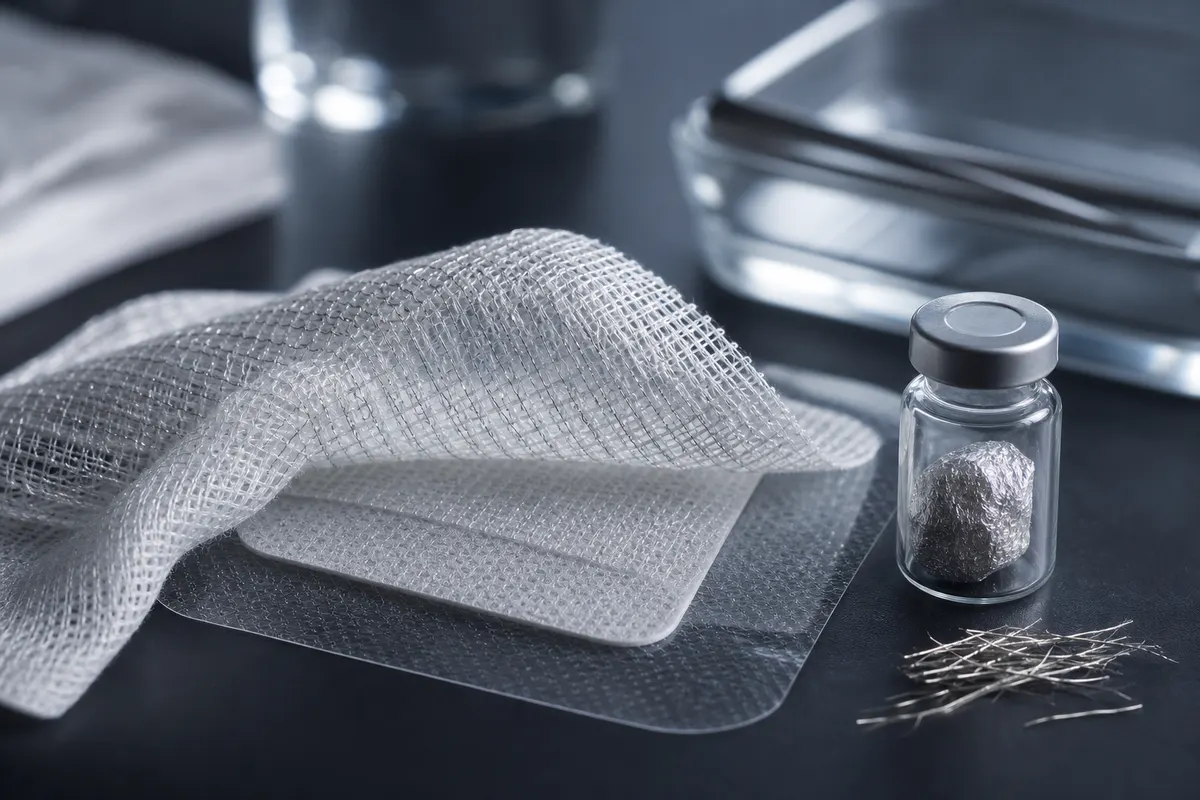
Silver dressings are among the most important clinical advances in wound management over the past three decades. These dressings contain a layer of metallic silver or nano-silver and release silver ions (Ag⁺) upon contact with wound fluid. Silver ions keep the wound environment antimicrobial, reduce odor, and in many cases significantly shorten healing time. For producers, access to 999.9 purity silver is a critical raw material that determines therapeutic quality and patient safety.
Types of Silver Dressings
The global silver dressing market includes several main families: silver foam dressings (such as Mepilex Ag), silver alginate dressings, silver hydrofibers (Aquacel Ag), silver meshes, and silver hydrocolloid dressings. Each type is designed for a specific wound. Foams suit moderate to heavy exudate; hydrofibers suit deep and tunnel wounds; meshes suit extensive superficial wounds.
Silver content per dressing varies — typically 0.5 to 1.5 mg per square centimeter. The dose must be sufficient for antimicrobial effect without harming healthy tissue. Precise formulation and uniform silver distribution depend directly on primary silver quality.
Clinical Indications
Silver dressings are widely used for diabetic wounds, pressure ulcers, second- and third-degree burns, infected wounds with purulent exudate, and surgical wounds with infection. In ICU and burn units they are standard equipment.
Action goes beyond antibacterial effect: silver reduces local inflammation and some studies suggest it aids tissue regeneration. However, silver dressings are not suitable for all wounds — dry non-infected wounds or those with heavy necrotic tissue may need other treatments.
Dressing Change Protocol and Duration
Depending on dressing type and wound status, change every 1 to 7 days. Saturated dressings should be changed sooner. The treating physician sets timing based on tissue condition.
Production Standards and Quality
Silver dressing production follows ISO 13485 (medical devices) and ISO 10993 (biological evaluation). Required tests include silver ion release, cytotoxicity, sensitization, and skin irritation. Primary silver impurities — especially heavy metals — can cause biotest failure.
Bazaarnoghre supplies 999.9 industrial silver with valid lab certificates. Dressing producers can use this raw material confidently in impregnation and coating. See ../../../index.html#products for details.
Global Market and Iran Opportunities
The global advanced wound dressing market exceeds $10 billion annually with growing silver product share. In Iran, rising diabetes prevalence and aging population increase demand for advanced dressings. Importing foreign products is costly; domestic production with quality raw material can be a cost-effective alternative.
Main challenge for domestic producers is access to pure silver with stable price and export documentation. Bazaarnoghre covers this need with domestic supply and long-term contract options.
| Dressing Type | Suitable For | Change Interval | Approx. Silver |
|---|---|---|---|
| Silver foam | Moderate-heavy exudate | Every 3–7 days | 0.5–1.2 mg/cm² |
| Silver hydrofiber | Deep, tunnel wounds | Every 1–3 days | 1.0–1.5 mg/cm² |
| Silver mesh | Extensive superficial burns | Daily | Variable |
| Silver alginate | Dry wounds, mild infection | Every 2–5 days | 0.5–1.0 mg/cm² |
Notes for Clinicians and Producers
Physicians should check patient metal allergy history — silver allergy is rare. Producers must confirm silver stability under sterilization (autoclave or gamma). Silver may react with sulfur forming dark silver sulfide, which may change appearance but not necessarily reduce efficacy.
Cost-Benefit and Economic Analysis
Silver dressings appear 3 to 5 times more expensive per unit than standard dressings, but clinical cost-benefit analysis shows reduced hospital stay, less systemic antibiotic need, and fewer visits lower total treatment cost. An NHS England study showed silver dressings for diabetic wounds reduced annual care cost per patient by up to 30%.
For budget-constrained Iranian hospitals, domestic production with quality domestic silver can bring final price to acceptable levels.
Recent Innovations in Dressing Technology
Researchers develop smart silver dressings that change color to indicate infection. Combined silver-collagen dressings and microcurrent with silver are in trials. All require high-purity silver with stable specifications.
For nano-silver antimicrobial properties, read ../nano-silver-antibacterial/. Medical hub: ../. Price inquiry: ../../../index.html#contact.
Silver Supply Guide for the Dressing Industry
Bazaarnoghre supplies 999.9 silver bar, shot, and industrial silver with XRF/ICP-MS certificates, batch traceability, transparent pricing, nationwide delivery, and long-term contracts. See ../../../index.html#products and ../../../index.html#contact.
Summary
Silver dressings are the gold standard for infected and chronic wounds. Clinical and commercial success depends on primary silver quality, precise formulation, and medical device standards. With stable 999.9 silver from Bazaarnoghre, Iranian producers can compete regionally.
Further reading
Related articles
To view 999.9 fine silver products, visit the Bazaarnoghre products page.