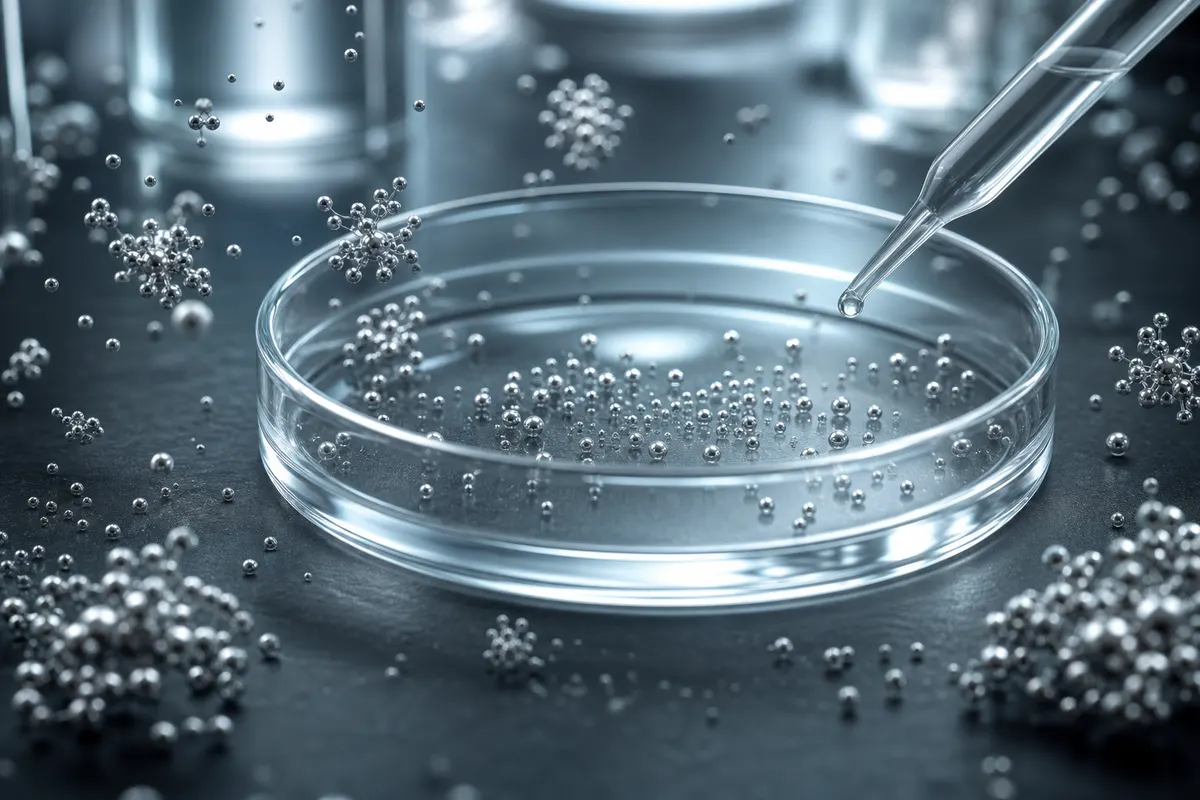
Antibacterial nano-silver is one of the most important innovations of recent decades in hygiene and medical devices. Silver particles at the nanometer scale — typically 1 to 100 nanometers — create very high contact surface with microorganisms and release silver ions (Ag⁺) in a controlled manner. These ions disrupt bacterial cell membranes, halt cellular respiration, and prevent microbial replication. Unlike traditional antibiotics, silver's multi-target mechanism means microbial resistance develops much more slowly; pharmaceutical and medical industries increasingly rely on 999.9 purity silver as a raw material.
Antimicrobial Mechanism of Nano-Silver
After entering microbial cells, silver ions react with sulfhydryl and amino groups on surface proteins. These reactions degrade membrane structure and increase permeability. Silver ions then bind to bacterial DNA and disrupt replication. Studies show nano-silver is effective against a wide range of gram-positive and gram-negative bacteria — including Staphylococcus aureus, Escherichia coli, and Pseudomonas aeruginosa. Some fungi and viruses are also vulnerable to silver's antimicrobial effects.
Particle size is decisive: smaller particles offer more surface and increase released ion concentration. Industrial production must guarantee uniform size distribution and colloidal stability — factors that depend directly on the quality of silver bar and shot used in synthesis.
Clinical and Hygiene Applications
Nano-silver is found in dozens of medical and hygiene products today: wound dressings, urinary catheters, breathing tubes, implant coatings, disinfectant solutions, and even hospital antibacterial fabrics. In burn units and chronic wound care, silver dressings shorten healing time and reduce secondary infection risk. In dentistry, silver compounds in toothpaste and sealants control plaque.
Medical device manufacturers must prove that released silver concentration stays within safe and effective limits for regulatory approval. This is where industrial silver supply with purity certificates and origin traceability matters. Bazaarnoghre supports medical device manufacturers' supply chains with 999.9 silver and laboratory documentation.
Comparison with Traditional Antiseptics
Alcohol and povidone-iodine have fast but transient effects and affect living tissue. Nano-silver can release ions gradually and maintain an antimicrobial environment for hours or days. This is critical for wound dressings requiring long-term protection.
Safety and International Regulations
The US FDA has approved some silver-containing products for specific uses. The EU specifies silver use in biocidal products under Biocidal Products Regulation (BPR). "Nano" does not mean "harmless"; dose, contact route, and duration determine safety. Toxicology studies show metabolized silver is excreted, but long-term argyria (skin discoloration) is possible with repeated contact.
Iranian producers targeting export must comply with ISO 10993 (biological testing of medical materials) and ISO 13485 (medical device quality management). Raw material quality — including heavy metal impurities such as lead, cadmium, and mercury — directly affects biotest results.
Production Process and Raw Material Quality
Industrial nano-silver production usually involves reducing silver salts such as silver nitrate with a reducing agent in a controlled environment. Primary silver purity determines final nano product impurities. 999.9 (three nines) means 999.9 parts per 1000 pure silver — the standard Bazaarnoghre offers for pharmaceutical supply.
After synthesis, characterization with UV-Vis, SEM, and DLS confirms particle size and shape. Without quality raw material, even the best synthesis process produces unstable product.
| Feature | Nano-Silver | Silver Ions (Ag⁺) | Silver Dressing |
|---|---|---|---|
| Mechanism | Gradual ion release | Direct solution effect | Continuous wound contact |
| Effect duration | Hours to days | Minutes | Until dressing change |
| Main use | Coatings and composites | Disinfectant solution | Chronic and burn wounds |
| High purity need | Very high | Very high | High |
Research Outlook and Iran Market
Iran has strong nanotechnology infrastructure and potential for domestic silver-containing products. Research projects at medical universities in Tehran, Shiraz, and Mashhad work on new nano-silver formulations. Dependence on imported pure silver remains the main industry challenge. Stable industrial silver supply at competitive prices opens this industry's bottleneck.
Nano-Silver in Hospital Environments
Hospitals are among the highest-risk settings for healthcare-associated infections (HAI). Antibiotic-resistant bacteria such as MRSA and VRE survive on bed surfaces, door handles, and equipment. Nano-silver coatings on high-touch surfaces can continuously reduce microbial load. Clinical studies in European and American hospitals show silver surfaces can reduce bacterial colony counts by up to 99%. Iranian private and university hospitals are gradually moving toward antimicrobial equipment, increasing industrial silver demand.
Antibacterial fabrics with nano-silver for hospital clothing, sheets, and OR curtains are in development. These embed nano-silver in polyester or cotton fibers during production, maintaining antimicrobial properties through up to 50 washes. Stability under washing and autoclave conditions depends on raw material quality.
Production Considerations and Scalability
Industrial nano-silver production has specific technical challenges: particle size control, preventing agglomeration, and maintaining colloidal stability. Green synthesis with plant extracts instead of strong chemical reducers is studied in Iranian universities. For medical use, standardized production with high reproducibility is essential. Each batch needs CoA including particle size, concentration, pH, and microbial count.
Scaling from lab to industrial production requires reactor investment and online QC systems. Producers using Bazaarnoghre 999.9 silver minimize batch-to-batch variance and smooth regulatory product registration.
For more on silver in dressings, read ../silver-medical-dressings/. Producers needing raw material: see ../../../index.html#products or inquire via ../../../index.html#contact. Other medical articles at ../.
Silver Supply Guide for the Pharmaceutical Industry
Pharma supply managers face silver price volatility, constant 999.9 purity needs, export documentation requirements, and competition with imports. A trusted domestic supplier offering lab certificates, batch traceability, and on-time delivery greatly reduces production risk.
Bazaarnoghre specializes in 999.9 silver bar, shot, and industrial silver for Iranian industries. Benefits include:
- Assay certificates with XRF and ICP-MS analysis
- Batch number and origin traceability for each bar
- Transparent pricing based on global market
- Delivery in Tehran and nationwide shipping
- Free technical consultation on product selection
- Long-term supply contracts with fixed or formula pricing
Review ../../../index.html#products before ordering. For daily price quotes and CoA samples, use ../../../index.html#contact. Related articles at ../.
Conclusion
Nano-silver combines ancient tradition with modern technology. Multi-target antimicrobial mechanism, broad spectrum, and integration into diverse materials make it valuable for pharma and medical industries. Success depends on raw material quality, process control, and safety standards — three pillars Bazaarnoghre supports in its supply chain.
Further reading
Related articles
To view 999.9 fine silver products, visit the Bazaarnoghre products page.