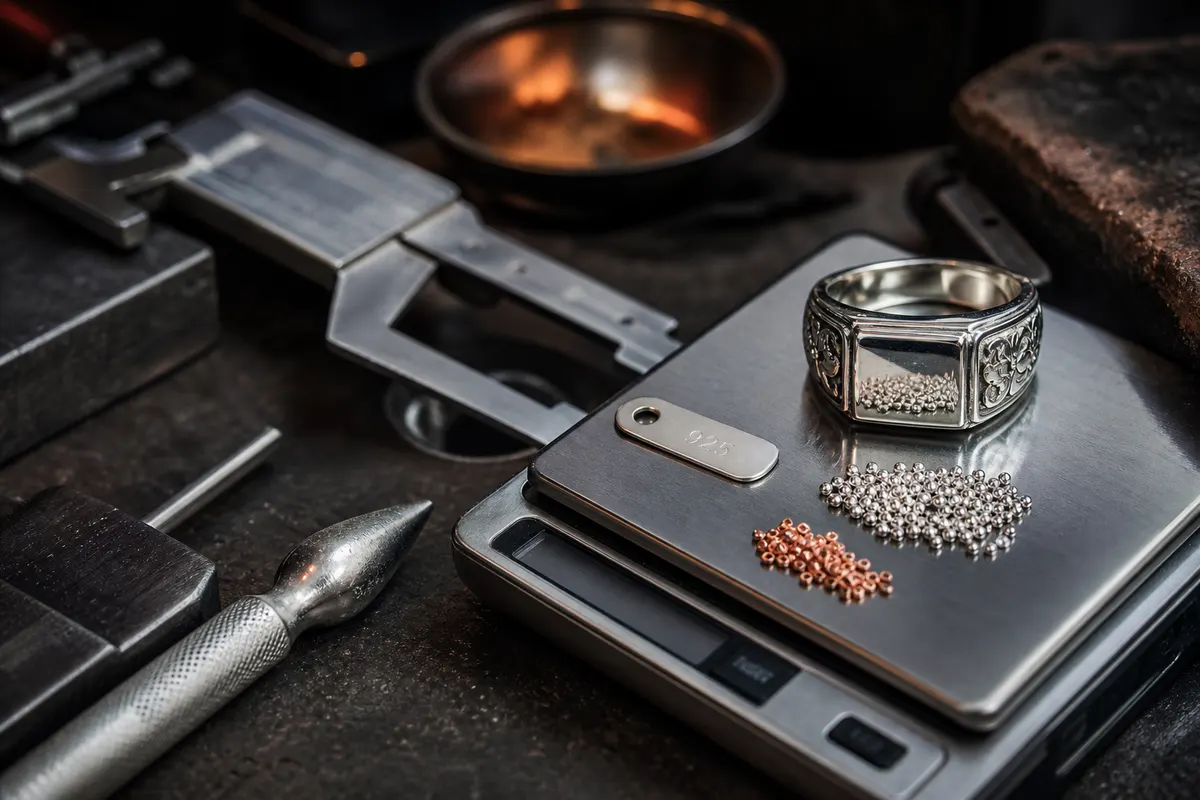
925 silver (Sterling Silver) is the most widely used alloy in jewelry making and goldsmithing — a blend of 92.5% pure silver and typically 7.5% copper that gives the metal hardness, durability, and polishability. If you have encountered terms like "sterling," "English silver," or the mark 925 in your workshop, you are working with this same international standard. By contrast, 999.9 silver refers to ingots or granules with a purity of 999.9 parts per thousand (or 99.99%) — the primary raw material for alloy production, casting, and many industrial processes. Understanding the difference between the two is critical not only for choosing the right raw material, but also for the final product quality, total cost, and customer satisfaction.
Many beginner goldsmiths assume "purer silver is always better," yet silver with near-100% purity is unsuitable for rings, bracelets, or earrings — it is soft, dent-prone, and scratch-sensitive. On the other hand, 999.9 silver in the workshop serves as the "base raw material" and is converted to 925 silver or other formulas after alloying. In this article from ../, we examine the differences technically and practically so you can make informed choices for each project.
What Is 925 Silver from a Chemical Composition Standpoint?
The global 925 silver standard states that a minimum of 925 parts out of every 1,000 must be pure silver. The remainder is usually copper — a metal that largely preserves silver's conductivity and luster while providing the mechanical hardness needed for everyday use. In some countries, similar alloys add trace amounts of zinc, germanium, or other elements to reduce oxidation (tarnishing), but the base 925-to-75 ratio remains unchanged.
Common marks on products include 925, Sterling, SS, or in some markets the phrase "925 silver" stamped or cast in the local language. According to ISO 9202, this marking is essential for transparency in international markets. If you plan to sell finished products to consumers, using certified, traceable 925 silver increases buyer confidence.
Why Is Copper Added to 925 Silver?
Pure silver (999+ fineness) is crystallographically soft and deforms under pressure or impact. Copper strengthens the crystal lattice through solid-solution hardening. The result: a 925 silver ring lasts for years, while a ring made from 999 silver without alloying loses its shape after a short time. However, adding copper slightly increases susceptibility to oxidation — which is why proper storage and occasional rhodium plating for luxury products are recommended.
What Is 999.9 Silver or Fine Silver Bullion?
999.9 silver refers to metal with a purity of 999.9 parts per thousand — meaning a maximum of 0.01% impurity. This material is usually supplied as ingots, granules, or shot from reputable refineries and forms the basis for jewelry, industrial, and investment alloys. In a goldsmith's workshop, 999.9 silver bullion is melted with copper or other metals to produce 925 silver, or used directly for sand casting and special molds when a ready alloy is employed.
The main difference lies in the stage of use: 999.9 silver is "raw feedstock"; 925 silver is a "semi-finished or finished product" for jewelry. Buying 999.9 silver from suppliers such as ../../../index.html#products who provide purity certificates and batch traceability reduces the risk of impurities like lead or cadmium that are dangerous in alloying.
Comparison Table: 925 Silver vs 999.9 Silver
| Criterion | 925 Silver (Sterling) | 999.9 Silver |
|---|---|---|
| Pure silver content | 92.5% (minimum) | 99.99% |
| Typical added metal | Copper (7.5%) | No alloy — only trace impurities |
| Hardness & durability | High — suitable for everyday jewelry | Very low — soft and dent-prone |
| Primary use | Rings, earrings, bracelets, flatware | Alloying, casting, industry, investment |
| Marking | 925 / Sterling | 999.9 / Fine Silver |
| Price per gram | Varies by process and brand | Close to global fine silver price |
| Oxidation tendency | Moderate — restorable with polishing | Lower in pure form; increases after alloying |
Applications of Each in the Jewelry Industry
In professional workshops, the typical flow is: purchase high-purity 999.9 silver or granules, in-house melting and alloying or purchase of ready 925 sheet and wire, then cutting, forging, soldering, and final finishing. Some workshops prefer to make their own alloy for full control over copper ratio and melt quality; others buy standard 925 sheet from suppliers to save time.
For delicate pieces such as fine chain or engraved plaques, 925 silver offers a good balance of workability and strength. For sculpture or large decorative pieces requiring precise casting, production often starts with high-purity silver granules — covered in detail in ../silver-granule-casting/. For alloy formula selection, see also ../jewelry-alloy-guide/.
Pros and Cons of 925 Silver for Goldsmiths
Advantages: Excellent solderability, accepts polishing and plating, globally recognized standard, ability to sell with a 925 label and transparent pricing for customers. Many buyers worldwide look for this fineness when purchasing silver.
Disadvantages: Greater sensitivity to humid and sulfur-rich environments (tarnishing), need for care and customer education on periodic polishing, and possible allergy in people sensitive to copper — though this is rare. To reduce this risk, some manufacturers use nickel-free alloys with higher standards.
The Role of 999.9 Silver in the Workshop Supply Chain
A professional goldsmith typically keeps both types in stock: 999.9 silver for custom alloying or inventory replenishment, and ready 925 silver for short-lead-time projects. The quality of incoming 999.9 silver directly affects the luster and uniformity of the final alloy; metallic impurities such as lead can dull the alloy color and complicate soldering.
Bazaarnoghre, as a specialist supplier of 999.9 silver, offers standard ingots and granules with laboratory certificates so workshops can enter the alloying stage with confidence. Price quotes and technical consultation for choosing weight and form (ingot, granule, shot) are available through ../../../index.html#contact.
How to Verify the Authenticity of 925 and 999.9 Silver
For finished 925 products, acid testing (with caution and experience), standard hallmark inspection, and XRF testing at gemological labs when in doubt are recommended. For raw 999.9 silver, request a purity certificate from the supplier, check for uniform appearance of granules or ingots, and match weight to invoice specifications. Never bring raw material into the workshop without a reputable source — the cost of rework and brand damage far exceeds any initial savings.
Common Mistakes When Choosing Between 925 and 999.9 Silver
One frequent error is buying 999.9 silver intending to make finished products directly without alloying — the result is usually a soft, scratch-prone piece and dissatisfied customers. Another is using 925 sheet from an unknown source for high-value products without purity testing. Some workshops also fail to maintain the copper ratio in in-house alloying and the final product does not meet the 925 standard — a problem in export markets and with informed customers.
The solution: define a clear material flow in the workshop — 999.9 silver only for melting and alloying, 925 silver for fabrication — and record ratios in production logs. Staff training and warehouse labeling prevent unintended mixing.
Summary: Which Should You Buy?
If your goal is to make and sell finished jewelry, 925 silver (self-made or ready-made) is the primary choice. If your workshop alloys or does casting, 999.9 silver is your base material. Many successful workshops manage both and draw from the appropriate stock based on order type. For wholesale buying criteria and supplier selection, read ../silver-buying-jewelers/ and visit ../../../index.html#products for product details.
Further reading
Related articles
To view 999.9 fine silver products, visit the Bazaarnoghre products page.