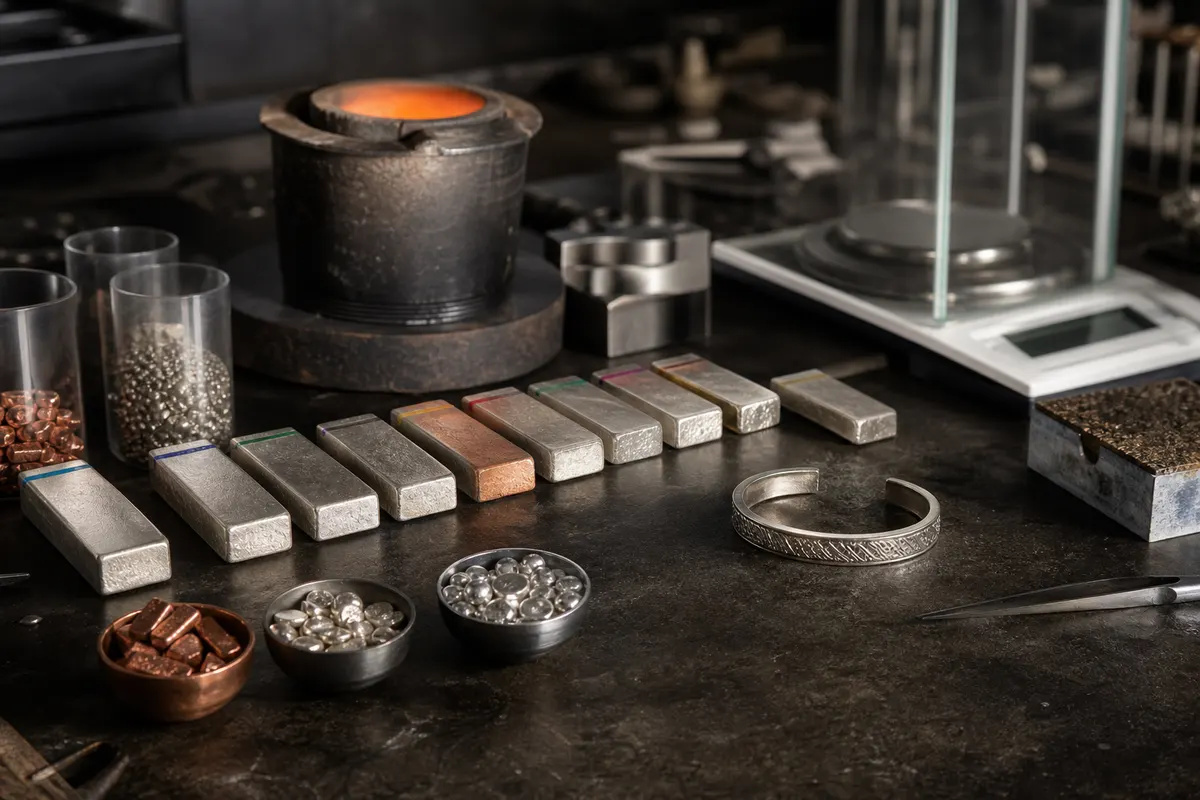
Choosing the right silver alloy for jewelry making is one of the most important technical decisions every goldsmith and jeweler faces. Silver alone, though brilliant and valuable, is too soft and wear-prone for most jewelry applications — which is why the jewelry industry has used combinations of silver with other metals for centuries to balance beauty, durability, workability, and cost. Knowing common alloys — from standard 925 silver to strengthened formulas and casting-specific blends — helps you produce pieces that meet market standards and customer expectations for durability and appearance.
In Iran and global markets, jewelry silver alloys are dominated by 925 silver (sterling); but depending on the work — fine hand fabrication, precision casting, extensive soldering, or rhodium plating — another formula may perform better. In this article from the jewelry section of ../, we compare widely used alloys and provide practical selection criteria for small workshops and industrial production. If you are new to 925 silver, we recommend reading ../sterling-silver-925/ first.
Why Do We Need Silver Alloys?
High-purity silver (fine silver) offers exceptional conductivity and luster, but is mechanically weak: it scratches easily, bends, and loses its original shape under repeated load. Adding another metal — mainly copper — strengthens the metal lattice and makes melting point, hardness, and forging behavior controllable. The goal of alloying is not to reduce value, but to turn raw silver into a practical material for the jewelry industry.
Besides copper, trace amounts of zinc, germanium, silicon, or boron are sometimes added to improve tarnish resistance. Every addition must comply with safety standards and local regulations; verified 999.9 silver from ../../../index.html#products provides a reliable base for custom alloying.
Common Alloys in the Jewelry Industry
925 Silver (Sterling Silver)
The world's most common alloy: 92.5% silver and 7.5% copper. The recognized standard for rings, earrings, bracelets, and flatware. Good balance of hardness, solderability, and cost. Most customers buying "silver" are actually buying 925 silver products.
950 Silver (Britannia Silver)
Contains 95% silver and 5% copper (or sometimes another mix). Softer than 925 but brighter. Used in some countries for coins and high-value silver objects. Suitable for delicate work requiring mirror polish, but less durable than 925 in everyday wear.
800 Silver
An alloy with 80% silver; more common in historic European and some Asian markets. Harder and cheaper, but lower luster and perceived value. Rarely seen in luxury production today.
Casting-Specific Alloys
For precision casting (lost-wax and sand casting), formulas are designed for better fluidity and reduced porosity. These alloys may include trace elements beyond copper. Feedstock often comes from high-purity silver granules — covered in ../silver-granule-casting/.
Comparison Table: Silver Alloys for Jewelry
| Alloy type | Silver % | Hardness / durability | Best use | Key note |
|---|---|---|---|---|
| Sterling 925 | 92.5% | High | Everyday jewelry, extensive soldering | Global standard; sellable with 925 label |
| Britannia 950 | 95% | Medium | Decorative objects, high polish | Softer; needs more care |
| 800 silver | 80% | Very high | Historical use, some frames | Less luster than 925 |
| Casting alloy | Usually near 925 | Variable | Complex cast parts | Fluidity and porosity matter more than raw hardness |
| Fine silver 999+ | 99.9%+ | Very low | Alloying, thin decorative sheet | Base material — not typical finished product |
Alloy Selection Criteria by Work Type
Forging and hand fabrication: Standard 925 silver is the best choice. 925 sheet and wire bend, cut, and solder easily. If your design has very fine details and low mechanical stress, you may try 950.
Casting: Use a casting alloy or granules designed for good flow. Starting with 999.9 silver and adding copper under precise temperature control is common in experienced workshops. Melt uniformity and correct temperature are critical.
Plating and final finishing: All the above alloys accept rhodium, gold, or other coatings; but the surface must be clean and oxide-free before plating. Alloys with higher copper may need more surface preparation.
Products with constant skin contact: Nickel-free 925 silver with verified purity is a safer choice. Avoid unknown alloys from unverified sources that may contain nickel or lead.
In-House Alloying or Buying Ready-Made?
Large workshops often alloy in-house: melt 999.9 silver, add pure copper in exact ratio, stir, and cast into small ingots or sheet. Advantages: full control, savings at scale, custom formulas. Disadvantages: melting equipment, safety knowledge, and time required.
Smaller workshops usually buy ready 925 sheet, wire, and granules and focus on design and fabrication. Both approaches are valid; the choice depends on production volume, team expertise, and raw material access. Bazaarnoghre supports both paths with 999.9 silver and standard granules.
Role of Raw Material Quality in the Final Alloy
Even the best alloy formula fails with impure base silver. Impurities such as lead, cadmium, or iron can yellow or dull the color, make soldering difficult, and in rare cases create health risks. Always buy from a supplier providing purity certificates and batch numbers. For a broader wholesale buying guide, see ../silver-buying-jewelers/.
Storage and Alloy Stability Over Time
Copper-based alloys tarnish when exposed to air, moisture, and sulfur compounds. Storage in sealed containers, anti-tarnish bags, and customer education on gentle polishing extend product appearance life. "Tarnish-resistant" alloys with germanium or other elements reduce this problem but may cost more.
Silver Alloys in the Iranian Market and Export Standards
Domestic customers mainly know "925 silver" and expect a 925 stamp on products. For export to Europe and America, compliance with ISO 9202 and purity documentation when requested by wholesale buyers matters. Workshops planning export expansion align alloy and raw material from the start with international standards to avoid future process changes.
Final product pricing also depends on alloy type: 950 or rhodium-plated pieces usually command higher prices in the luxury segment, while 925 is the main mid-range and everyday luxury product. Knowing your product's market position helps alloy selection.
Alloy Quality Control in the Workshop
After each alloying batch, record silver and copper weights used, melt temperature, and ingot appearance. In sensitive production, random sampling and monthly XRF testing are low-cost ways to prevent non-standard output. If buying ready alloy, compare each new shipment with the previous one for color and hardness during finishing — noticeable differences signal a source or formula change.
Summary and Practical Recommendation
For most goldsmiths and jewelers, 925 silver is the best starting point and primary choice. For special work, consider 950 or a casting formula. Always source alloy base from verified 999.9 silver and contact the Bazaarnoghre team via ../../../index.html#contact for technical advice. Product forms are available at ../../../index.html#products.
Further reading
Related articles
To view 999.9 fine silver products, visit the Bazaarnoghre products page.