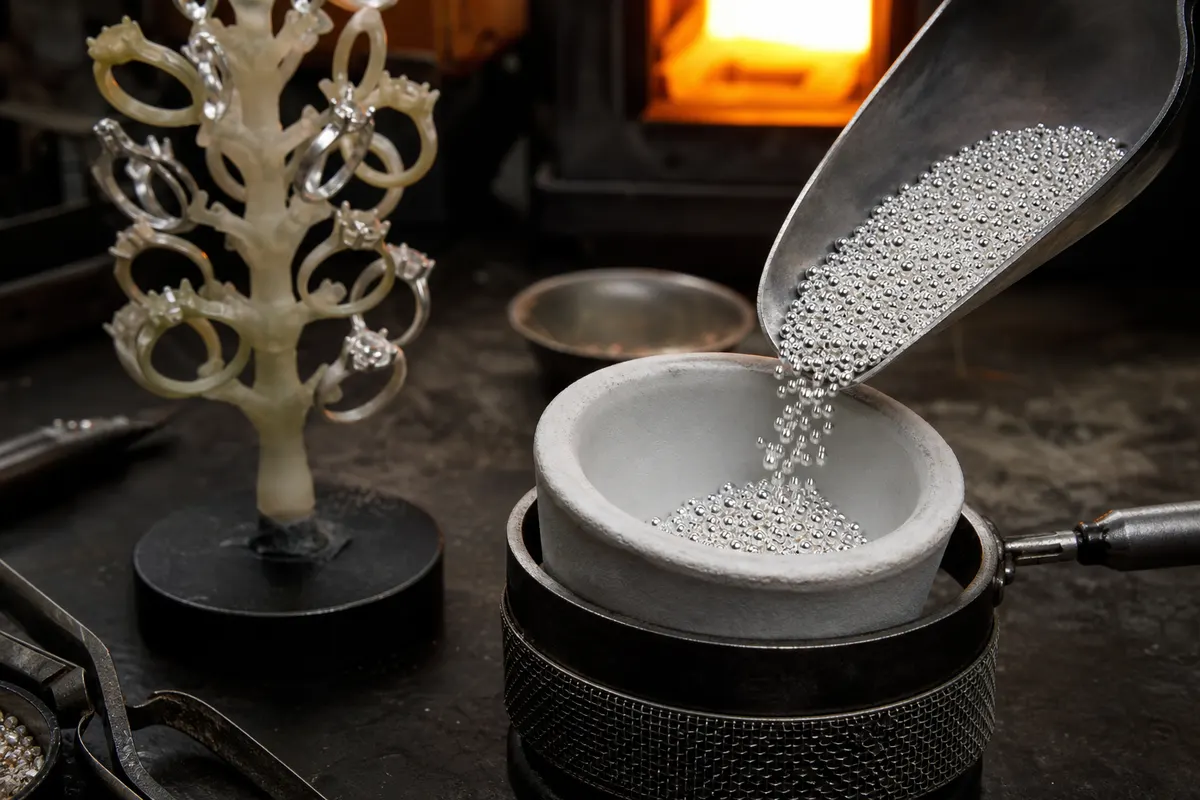
Silver granules are one of the most widely used raw material forms in jewelry and goldsmith casting workshops. Small, uniform silver grains enable faster melting, more precise weight measurement, and better control over alloy ratios. Whether in lost-wax casting or sand casting and small ingot production for forging, silver granules for casting are the standard starting point for many professional manufacturers. Granule quality — purity, grain size uniformity, and absence of harmful impurities — directly affects casting success, surface quality, and final product durability.
In the market, silver granules are offered in various fineness grades; but for serious jewelry production, 999.9 purity (or close to it) is recommended so that after alloying to 925 silver or a casting formula, results are predictable and repeatable. In this specialist guide from ../, we review granule selection through melting and safety considerations. For understanding the difference between raw silver and final alloy, see ../sterling-silver-925/ and ../jewelry-alloy-guide/.
What Are Silver Granules and How Are They Produced?
Granules are small round or semi-round metal grains, usually produced by melting fine silver and pouring into water or a controlled environment. Grain size ranges from a few millimeters to finer particles. Uniform grain size helps achieve even melting and reduces weighing errors. 999.9 silver granules from reputable refineries are produced under international standards and supplied with purity certificates.
Some suppliers also offer pre-alloyed granules (e.g., ready 925), suitable for workshops that do not want to perform alloying themselves. However, larger workshops usually buy fine granules and add copper or other elements separately for full control.
Advantages of Silver Granules Over Ingots for Casting
Faster melting: The high surface area of grains allows heat to transfer more quickly and reduces furnace time. Accurate measurement: Exact granule weight can be weighed for each mold or production batch. Less waste: Ingot cutting and scrap are eliminated. Flexibility in alloying: Mixing granules with pure copper or copper granules to reach the desired ratio is easier.
Silver ingots remain suitable for long-term storage and some ingot-to-sheet casting processes; but for frequent casting and serial production, granules offer higher efficiency.
Granule Selection Guide by Application
| Application | Recommended purity | Grain size | Technical note |
|---|---|---|---|
| Lost-wax casting | 999.9 or ready 925 alloy | Medium (2–5 mm) | Uniform melt temperature; proper degassing |
| In-house alloying | 999.9 | Fine to medium | Accurate weighing with pure copper |
| Small ingot / sheet production | 999.9 | Varied | Casting in graphite or stone mold |
| Uniform mass production | Standard 925 alloy | Uniform | Reduced batch-to-batch variation |
| Testing and prototyping | 999.9 | Fine | Low consumption with high precision |
Melting and Casting Process: Key Points
The melting furnace must reach appropriate silver temperature (around 960°C for fine silver). Use ceramic or graphite crucibles, gentle stirring for homogenization, and avoid overheating that causes gas absorption and porosity. Before pouring into the mold, degassing with suitable materials or vacuum techniques is used in professional production.
For lost-wax casting, centrifugal or pressure systems are chosen depending on workshop scale. Mold quality, metal temperature at pour, and cooling time affect the final appearance. Granules with high impurity content can cause bubbles, holes, and color inconsistency — another reason to buy from a reputable source.
Safety When Working with Granules and Molten Silver
Melting hot metals poses burn, splash, and harmful gas risks. Safety glasses, heat-resistant gloves, adequate ventilation, and operator training are mandatory. Furnaces and equipment should be inspected regularly. Never pour water directly onto hot metal.
Converting 999.9 Silver Granules to Jewelry Alloy
After melting fine granules, pure copper or copper granules are added in the required ratio (e.g., 7.5% for 925) and stirred. Melt temperature must be sufficient for complete copper dissolution. The homogeneous metal is then transferred to small ingots, sheet, or directly to the casting system. Recording ratios and raw material batch numbers is essential for quality traceability in industrial production.
If you have a custom casting formula, documentation and repeatability matter as much as purity. Bazaarnoghre supplies 999.9 silver granules with laboratory certificates so your alloy base is reliable.
Silver Granule Purchase Criteria for Workshops
When buying, consider: declared purity and test certificate, uniform grain size, absence of moisture and contamination (proper packaging), transparent pricing by net weight, and reliable ongoing supply for uninterrupted production. Comparing price by gram alone without checking purity can be misleading.
For wholesale buying and supplier selection, read ../silver-buying-jewelers/. Inquiry and ordering are available through ../../../index.html#contact; product specifications at ../../../index.html#products.
Common Casting Problems and Granule Quality
Porosity and bubbles: Usually caused by gas, moisture, or overheating — sometimes worsened by impure granules. Incomplete mold fill: Low metal temperature or alloy with poor flow. Hot tearing: Sudden cooling or mold stress. Dull color: Metallic impurities in granules. Systematic troubleshooting and standard raw materials resolve most issues.
Basic Equipment for Working with Silver Granules
A casting workshop needs at minimum a melting furnace (induction or gas), resistant crucible, tongs and hooks, digital scale with 0.01 g precision, and at larger scale a centrifugal casting system. Initial investment in quality equipment prevents granule waste and defective products long term. Operator training in temperature control and pour timing matters as much as granule selection.
For growing workshops, starting with small granule orders from a reputable supplier and testing the process on simple molds before mass production is sensible. Bazaarnoghre offers varied weight packages for this trial phase. Comparing true cost per cast piece — including granules, gas, furnace power, and labor — helps decide on wholesale purchase.
Storing Silver Granules in the Workshop
Keep granules in clean, dry plastic or metal containers. Contact with chemicals, environmental dust, and high humidity should be minimized. Labeling receive date and batch number on each container helps traceability if quality issues arise. Before melting, if surface oxide is visible, light polishing or appropriate washing per workshop protocol is recommended. In humid regions, monthly inventory checks and sealed containers prevent loss from surface oxidation.
Summary
999.9 silver granules are a primary tool for many jewelry casting workshops. Choosing the right grain size, controlled melting, and precise alloying form the basis of quality production. With supply from Bazaarnoghre and technical consultation, you can keep your production chain stable and reliable. Investing in quality raw material is the most economical way to reduce waste and rework on the production line.
Final reminder: evaluate each new granule batch with a test casting before mass production. Changing supplier or batch number may require slight temperature or pour time adjustments. Documenting these settings in the workshop technical log ensures repeatability and consistent quality. Regular communication with your supplier about stock and delivery keeps your production schedule uninterrupted. For order coordination and purity certificates with each shipment, contact ../../../index.html#contact.
Further reading
Related articles
To view 999.9 fine silver products, visit the Bazaarnoghre products page.