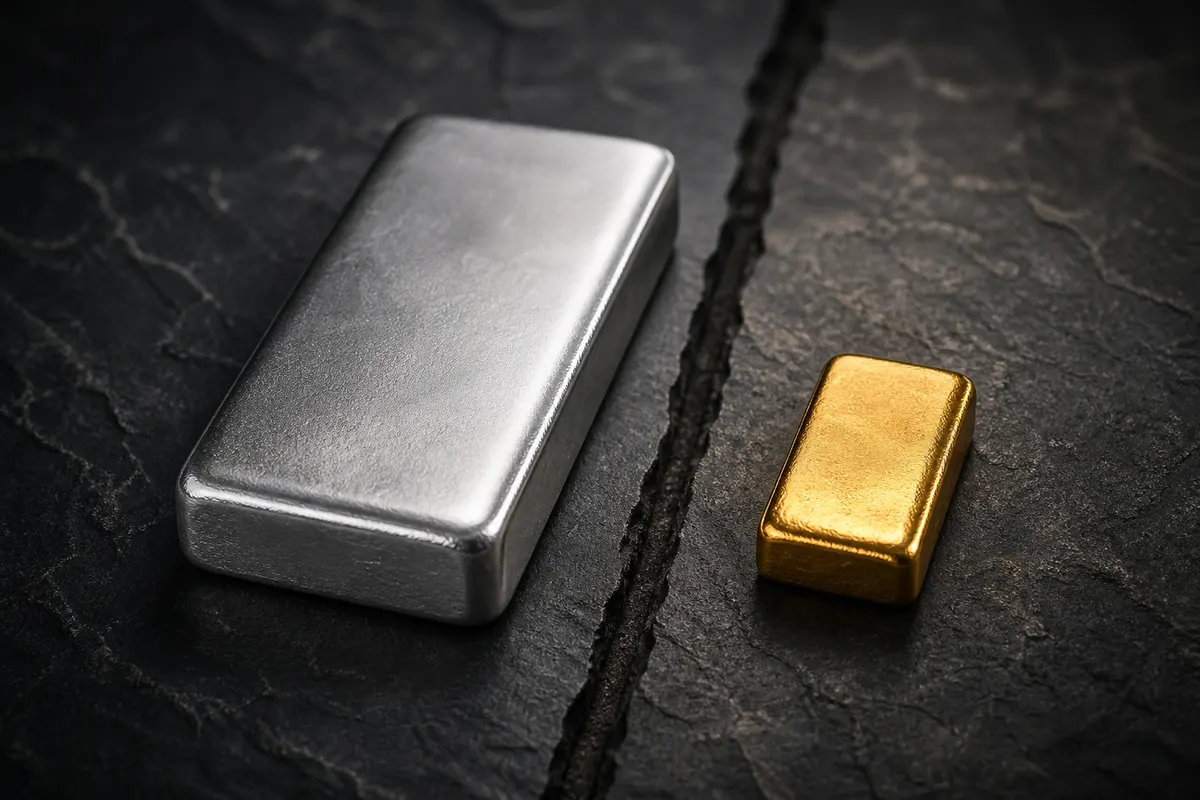
The question silver or gold is asked daily in investment groups, but there is no one-line answer. Both precious metals have thousands of years of store-of-value history, both hedge against inflation, and both are accessible physically (coins, bars, jewelry) or through paper instruments. The main differences lie in price volatility, industrial demand share, storage cost, and liquidity. If you plan to buy 999.9 silver bars, this comparison helps you set a sensible share for each metal in your portfolio.
This article is from ../. For physical silver buying details see ../silver-bar-investment/; for price drivers see ../silver-price-factors/.
History and Role of Each Metal in a Portfolio
Gold has for centuries been a symbol of wealth and a central-bank reserve asset. More than 20% of gold demand comes from investment and official reserves. Silver is a dual metal: both an investment asset and an industrial raw material. That duality lets silver benefit from industrial demand in economic expansion while still acting as a haven in crises — though usually with greater volatility.
In many markets gold dominates jewelry and coins; silver is less mainstream but has gained attention from retail investors as 999.9 bar pricing and reputable sellers such as Bazaarnoghre have become more transparent.
Price Volatility: Risk and Opportunity
Silver has historically shown greater volatility than gold. In precious metals bull markets, silver often rises by a larger percentage; in corrections it can fall more sharply. For short-horizon investors that can be stressful. Over five to ten years, medium-term swings matter less.
Gold suits more conservative investors; silver suits those with higher risk tolerance who want to capture larger percentage moves. Neither replaces diversification in other asset classes.
Gold-to-Silver Ratio: A Relative Value Tool
The gold-to-silver ratio is one of the oldest comparison metrics. The World Gold Council tracks it regularly. When the ratio is above 80, some analysts see silver as cheap relative to gold; below 50, the opposite. This tool helps with relative allocation, not certain prediction.
Example: at a ratio of 70, you need 70 ounces of silver to buy one ounce of gold. Investors holding both sometimes rebalance at extreme ratios.
Liquidity and the Physical Market
Gold — especially standard coins and common jewelry — has broad, immediate liquidity in most markets. Physical silver has a smaller but growing market. 999.9 bars with assay certificates from reputable sellers sell more easily than unstamped bars. Global silver coins (such as American Silver Eagles) may have less recognition in some local markets.
For silver liquidity, 999.9 purity, assay certificates, and buying from a known source are critical. Details are in ../silver-authenticity-storage/.
Storage Cost and Physical Volume
Silver is dense, but value per kilogram is lower than gold's. To store wealth equivalent to one kilo of gold, you need more silver by weight and volume — raising vault, safe-deposit, and insurance costs. Gold is more compact and economical for large holdings.
Silver also tends toward surface tarnish, which does not reduce metal value but requires proper care. Gold is chemically inert and easier to store.
Premium and Market Entry
For retail investors, silver is a lower-cost entry point. For the price of one gold coin, you can buy several times more weight in 999.9 silver — attractive for gradual diversification.
Silver vs Gold Comparison Table
| Metric | 999.9 Silver | Gold |
|---|---|---|
| Price volatility | High | Moderate to low |
| Industrial demand | Very high (over 50%) | Low (mainly investment and jewelry) |
| Local liquidity | Good and improving | Excellent |
| Physical storage cost | Higher (more volume) | Lower |
| Entry capital threshold | Low | Higher |
| Value in crisis | Good | Excellent |
| Best suited for | Portfolio growth, diversification, medium horizon | Stability, long-term store |
Portfolio Allocation: How Much Silver and Gold?
The answer depends on personal circumstances. A common framework among portfolio advisers:
- Conservative: 70–80% gold, 20–30% silver
- Balanced: 50–60% gold, 40–50% silver
- Aggressive: 30–40% gold, 60–70% silver
These figures are examples only; age, income, debt, goals, and risk tolerance decide. Some investors buy only physical silver because gold is beyond their budget — reasonable if they accept volatility risk.
When Does Silver Win?
When industrial demand is strong (solar growth, electronics expansion), silver may outperform relatively. When the gold-to-silver ratio is historically high and a metals upturn begins, silver often moves later but with greater momentum. Early entrants can benefit from that phase.
When Does Gold Win?
In deep financial crises, war, or severe instability, gold is usually the first haven. Central banks buy gold in such periods, not silver. For wealth preservation without sharp swings, gold remains the anchor — at a higher entry cost.
Must You Choose One?
No; many experts recommend combining both. Gold adds stability; silver adds growth potential and industrial diversification. If you are just starting, you can enter with 999.9 silver from ../../../index.html#products and add gold gradually. For allocation advice contact ../../../index.html#contact.
Tax, Legal Rights, and Transaction Transparency
In physical gold and silver trades, official invoices and compliance with buy/sell rules matter legally. Gold has a longer history in formal markets; 999.9 physical silver is still developing institutional trading in some regions. Buying from a licensed supplier with valid documentation reduces friction at resale or transfer.
Internationally, gold is the reserve asset of central banks — over 35,000 tonnes in official vaults. Silver has smaller official reserves but its industrial role in the global economy is expanding. That structural difference should be considered in long-term "silver or gold" analysis.
Common Mistakes Comparing Silver and Gold
Some investors look only at price per gram and ignore volatility, premium, and storage cost. Others expect silver to behave exactly like gold in every crisis — while in mild crises gold may lead first. Fair comparison requires the same time horizons, all-in costs, and local liquidity.
If your goal is multi-generational wealth preservation, a higher gold share is logical. If you seek portfolio growth over the next decade with accepted volatility, 999.9 silver can carry a larger share. Bazaarnoghre offers free consultations to help investors choose an appropriate mix by budget and goal.
Both metals can coexist in one portfolio: gold as the stability anchor and silver as the growth sail — a metaphor many portfolio managers use in emerging markets. The gold-to-silver ratio is a guide, not a mandatory buy/sell order.
Summary: Silver or Gold for You?
If stability and immediate liquidity are priorities, gold carries more weight. If you want economical entry, higher growth potential, and belief in industrial demand, 999.9 silver is a serious option. Many find the best answer in a smart combination. Follow daily price analysis in ../silver-price-factors/ and the buying guide in ../silver-bar-investment/.
Further reading
Related articles
To view 999.9 fine silver products, visit the Bazaarnoghre products page.