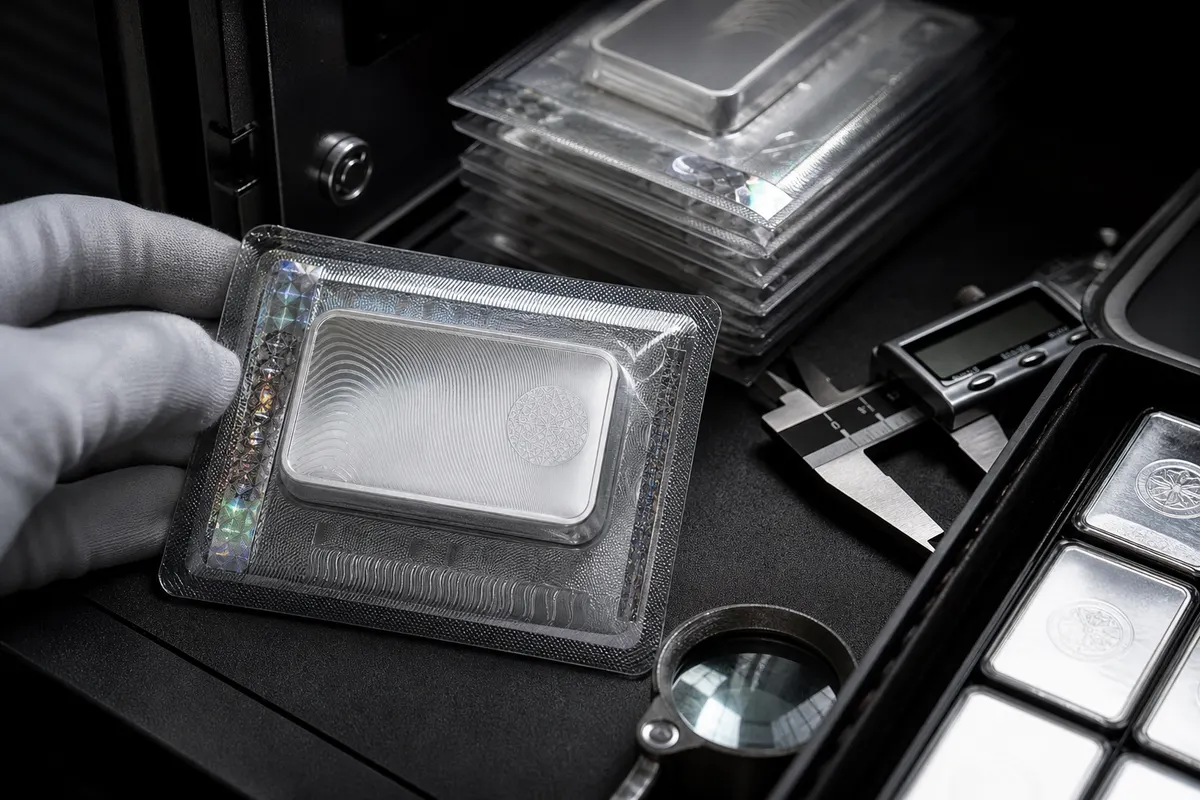
After buying silver bars, two challenges appear immediately: confirming that what you received is truly 999.9 silver, and keeping it in conditions that preserve value and resale ability. Verifying silver authenticity is not only for beginners — even experienced traders encounter fake bars, silver-plated base metal, or fineness below what is stamped on the surface. Improper storage may not reduce metal weight, but it affects appearance, packaging, and the next buyer's confidence.
This article from ../ complements ../silver-bar-investment/. To understand current value read ../silver-price-factors/ as well.
Why Authenticity Verification for 999.9 Silver Is Critical
999.9 means 99.99% purity — the global standard for investment bars. Even a half-percent fineness difference in a one-kilogram bar equals five grams of impurity with meaningful value. Fraudulent sellers use cheaper metals such as lead, tungsten, or silver-plated alloys. Without valid testing, visual inspection alone is impossible.
Buying from a reputable supplier such as Bazaarnoghre — bars with assay certificates, serial numbers, and tamper-evident packaging — reduces risk from the start. Still, knowing verification methods is essential for secondary market trades and private purchases.
Visual Signs of Genuine Silver Bars
None of these alone is sufficient, but together they provide useful signals:
- Refinery stamp: refinery name, logo, 999.9 or 9999 fineness, exact weight, serial number
- Original packaging: factory seal, hologram, scannable barcode
- Accompanying certificate: assay document with matching serial number
- Weight and dimensions: conformity with producer standards (abnormal deviation is suspicious)
Bars from producers on the LBMA Good Delivery List carry higher credibility in global markets.
Methods to Test Silver Authenticity
1. Laboratory Assay (Fire Assay)
The most accurate fineness test, performed at accredited laboratories. A sample is melted and true purity measured. Recommended for high-value transactions.
2. XRF Spectrometry
Non-destructive and fast but reads surface only. Plated or hollow bars can mislead. Suitable for initial screening.
3. Density Test (Water Displacement)
Pure silver density is about 10.49 g/cm³. Formula: weight in air divided by (weight in air minus weight in water). Requires a precise scale and water container. More reliable for solid bars than small pieces.
4. Magnetic and Sound Tests
Pure silver is non-magnetic — a magnet should not stick. A strike on genuine silver produces a distinct ring — but interpretation is subjective and not a substitute for scientific testing.
5. Nitric Acid (Not Recommended)
Acid drop reacts on silver surface but scratches it and is unsuitable for investment bars. Refer to a laboratory instead.
Common Frauds and How to Avoid Them
Typical cases include hollow bars weighted with lead inside, thin silver plating on copper or tungsten, forged assay certificates with mismatched serials, and below-market sales with urgency and psychological pressure. If an offer looks too good, there is likely a problem.
Golden rules: buy only from known sellers via ../../../index.html#products, verify certificates, avoid second-hand purchases without retesting, and never trade without an official invoice. If in doubt contact ../../../index.html#contact.
Proper Storage of 999.9 Physical Silver
Unlike gold, silver reacts with sulfur and moisture in air, forming silver sulfide (surface darkening). This surface tarnish does not change metal weight but changes appearance. Proper storage includes:
- Dry environment with relative humidity below 50%
- Away from sulfur sources (rubber, some adhesives, naphthalene)
- No contact with salt or chemicals
- Anti-tarnish bags or storage in original factory packaging
Cleaning with a soft microfiber cloth is enough. Avoid abrasives and strong chemicals.
Storage Options: Home, Safe Deposit, Private Vault
Home Storage
For limited amounts, a theft- and fire-resistant home safe of adequate size is sufficient. Do not disclose location; home insurance may not cover precious metals — check policy terms.
Bank Safe Deposit Box
Higher security but annual cost and limited access hours. Logical for high-value bars. Keep invoice and certificate separate from physical silver location.
Specialist Vaults
Some countries offer dedicated precious metals vaulting. Where formal options are limited, safe deposit boxes and personal safes are more common.
Silver Storage Methods Comparison Table
| Storage method | Security | Annual cost | Access | Best for |
|---|---|---|---|---|
| Home safe | Moderate | One-time (safe purchase) | Immediate | Up to several kilograms |
| Bank safe deposit | High | Moderate to high | Business hours | High value |
| Original factory packaging | — | Low | — | Tarnish protection |
| Anti-tarnish bag | — | Low | — | Complement to other methods |
Insurance and Asset Documentation
Photograph bars with readable stamp and serial, copy assay certificate and purchase invoice, and store serial numbers in secure cloud storage. In theft or fire, these documents are essential for insurance claims. Some insurers accept precious metals with additional coverage.
Never publish full serial numbers and bar details on social media.
Resale: Preserving Liquidity
At resale, buyers check certificate, intact packaging, and invoice. Bars with scratched surfaces or damaged stamps may trade at a discount. Keeping original packaging until sale is best practice. For resale price estimates read ../silver-price-factors/.
For comparison with gold, ../silver-vs-gold/ offers useful perspective.
Long-Term Storage: Advanced Tips
For large holdings (several kilograms), diversifying storage location reduces risk — part in safe deposit, part in home safe. Avoid visible labels on the bar surface; scratches on stamp or surface can raise doubts at resale. Environment temperature should be stable; sharp temperature and humidity swings accelerate tarnish.
Every six months check packaging and surface appearance without breaking factory seal. If moisture or mold appears in the container, fix the environment. Per silver's chemical properties, the metal is an excellent conductor and stable at room temperature — the issue is surface reaction with environment, not the metal itself.
Checklist Before and After Buying 999.9 Bars
- Quote from at least two reputable sources
- Verify assay certificate and matching serial
- Physical inspection of stamp and weight at delivery
- Receive official invoice simultaneously
- Choose dry, secure storage location
- Record details in personal file and cloud backup
- Review insurance coverage if needed
This simple checklist can prove invaluable years later at resale or insurance claim. For confident first purchase, read ../silver-bar-investment/ from start to finish.
Proper storage is as integral to investing as buying from a reputable source. Bazaarnoghre supplies 999.9 bars with certificates and advises on storage conditions and preparation for resale.
Summary
Authenticity and storage are two pillars of successful physical silver investment. Buy from a reputable seller with 999.9 certificates, retest when needed, and store in a dry, secure place. Bazaarnoghre offers certified bars and storage guidance — see ../../../index.html#contact and ../../../index.html#products for more.
Further reading
Related articles
To view 999.9 fine silver products, visit the Bazaarnoghre products page.