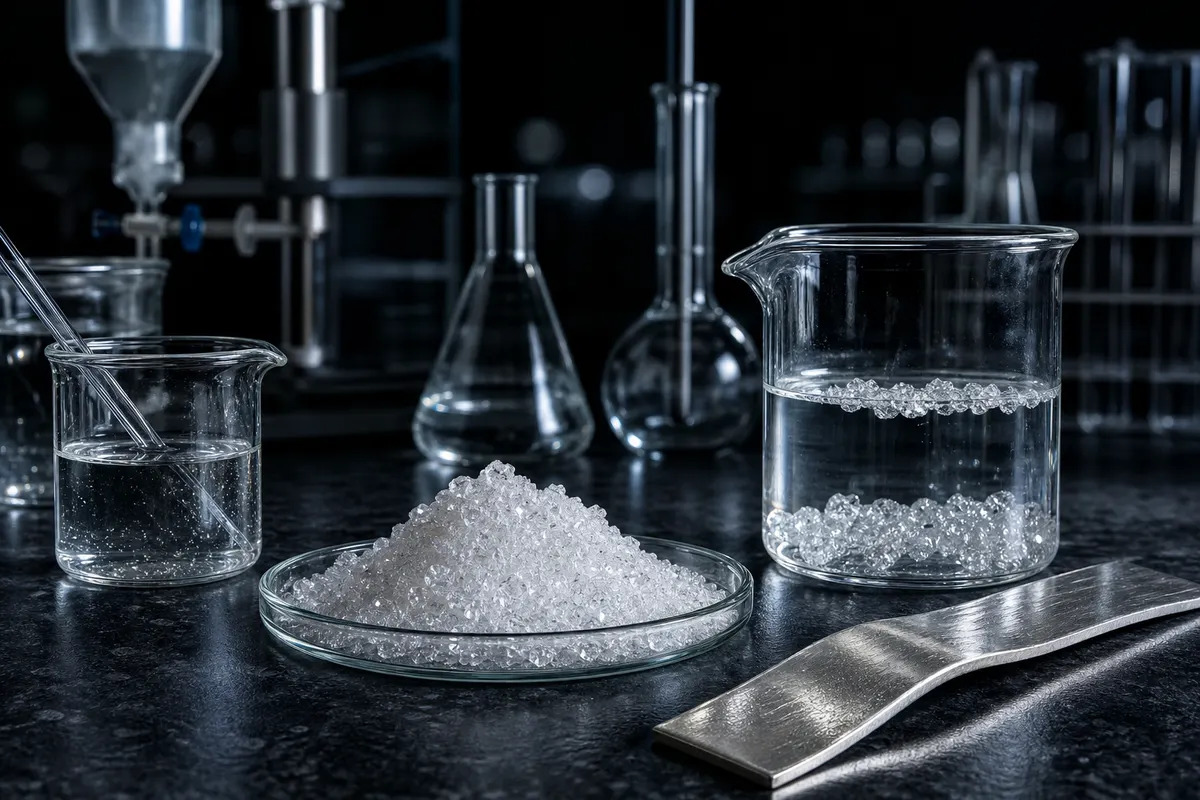
Silver nitrate (AgNO₃) is the best-known and most widely used silver compound in industry. This white crystalline material, soluble in water, with strong oxidizing and antimicrobial properties, is used in hundreds of industrial and laboratory processes. Global silver nitrate production runs to thousands of tonnes annually, and the supply chain begins with 999.9 pure silver — supplied by Bazaarnoghre.
Silver Nitrate Production: Industrial Process
The standard production method is reaction of metallic silver with nitric acid:
3Ag + 4HNO₃ → 3AgNO₃ + 2NO + 2H₂O
Pure silver (bar or shot) dissolves in concentrated or medium-strength nitric acid. NO (nitrogen monoxide) is produced as a by-product and usually recycled to HNO₃. The silver nitrate solution is purified, filtered, crystallized, and dried. Product purity ranges from 99% to 99.99% depending on industrial or laboratory grade. Control of metal impurities (Cu, Pb, Fe) and chloride ions is critical for sensitive applications.
Industrial Grades of Silver Nitrate
Silver nitrate is supplied in several commercial grades. Photographic grade has the highest purity for the photography industry (declining). Laboratory grade (ACS/Reagent) is for research and medicine. Technical grade is for catalyst, mirror, and plating production. Electronics grade has tight control of metal ions for silver deposition. Grade selection directly affects final product quality and cost.
Quality Control and Analysis
Common analyses include titration (AgNO₃ percentage), ICP-MS for trace metals, and chloride and sulfate tests. A Certificate of Analysis (CoA) with each industrial batch is essential.
Industrial Applications of Silver Nitrate
Major industrial consumers include:
Catalyst production: AgNO₃ solution is impregnated on Al₂O₃ carrier; after reduction, silver catalyst forms (see ../silver-catalyst-industry/).
Mirror making: Brashear or Tollen processes reduce silver nitrate with glucose or formaldehyde to create a silver mirror layer on glass.
Plating and coating: Silver electroplating baths are prepared from AgCN or AgNO₃.
Other compound production: Silver oxide, silver halides, and nano-silver are synthesized from silver nitrate.
Table: Silver Nitrate Specifications and Applications
| Property | Value | Related Application |
|---|---|---|
| Formula | AgNO₃ | — |
| Molar mass | 169.87 g/mol | Dosage calculation |
| Water solubility (20°C) | 216 g/100mL | Solution preparation |
| Density | 4.35 g/cm³ | — |
| Melting point | 212°C (decomposes) | Storage |
| Technical purity | 99–99.9% | Catalyst, mirror |
| Laboratory purity | 99.9–99.99% | Research, medicine |
Safety and Storage
Silver nitrate is an oxidizer and reacts with organic matter, phosphorus, and sulfides. Skin contact causes black stains (argyria). Store in dark glass or polyethylene containers, away from light and combustibles. Transport regulations classify it as oxidizer (Class 5.1). Workers should use gloves, eye protection, and adequate ventilation.
Supply Chain: From Silver Bar to AgNO₃
The chain runs from mine or recycled silver, refining to 999.9 bar, silver nitrate production, and use in catalyst or mirror. Primary silver quality directly affects AgNO₃ purity. Bazaarnoghre supplies 999.9 silver with assay certificates, strengthening the base of the silver compound production chain. Other compounds are covered in ../silver-compounds-industry/ and catalyst use in ../silver-ethylene-oxide/.
Silver Nitrate in Medicine and Dentistry
In medicine, 1% silver nitrate solution is used for cauterization and as a topical antiseptic. In dentistry, AgNO₃ treats tooth sensitivity and disinfects root canals. These applications require high (laboratory) purity. With the rise of nano-silver, some traditional AgNO₃ uses are being replaced, but silver nitrate remains in pharmacies and clinics.
Transport and International Regulations
Silver nitrate is shipped as oxidizer Class 5.1 under UN 1493. Packaging must comply with IMDG (sea) or IATA (air). "Oxidizer" and "Toxic" labeling is mandatory. Exporters and importers must obtain environmental and safety permits. AgNO₃ warehouses must be separate from combustibles, acids, and bases.
Market and Trends
As photographic use declines, silver nitrate demand in that sector has fallen, but growth in ethylene oxide catalysts and medical nano-silver has offset it. AgNO₃ price depends on metallic silver and nitric acid costs. Industrial buyers sign long-term contracts with AgNO₃ producers and primary silver suppliers. For ../../../index.html#products, ../../../index.html#contact, and the ../ chemical industry hub.
Export and Import of Silver Nitrate
Largest AgNO₃ producers are in China, the USA, Germany, and Japan. Main importers are petrochemical complexes, mirror plants, and plating units. In Iran, silver nitrate is produced from domestic or imported silver; quality primary silver from Bazaarnoghre can reduce chain dependency. Global AgNO₃ price is sensitive to LME silver and energy costs (for nitric acid).
Industrial-Scale Silver Nitrate Production
AgNO₃ plants are usually located near nitric acid suppliers or industrial zones with chemical access. Capacity ranges from a few tonnes to hundreds of tonnes per year. Batch or continuous process may be used. After crystallization, crystals are dried in vacuum dryers or tunnels. Packaging in double-layer polyethylene bags inside metal drums prevents light and moisture.
Silver Nitrate in Mirror Making
The Tollen (silver mirror) process reduces silver ammonia with sugar or formaldehyde to create a thin mirror layer on glass. Used in mirror production, glassware, and some decorative parts. Mirror quality depends on AgNO₃ purity and precise pH and temperature control.
Quality Control in AgNO₃ Production
The plant QC lab checks dozens of parameters daily: AgNO₃ percentage by chloride titration, solution pH, residual chloride, heavy metals by ICP, and crystal appearance (color, clarity). Rejected batches are reprocessed or sold at lower grade. Traceability from AgNO₃ batch to primary silver batch is mandatory for catalyst customers.
AgNO₃ Pricing and Supply Contracts
Silver nitrate is usually priced as a premium on metallic silver (LME + premium) plus chemical conversion cost. Large catalyst customers sign annual take-or-pay contracts. Silver price volatility directly affects AgNO₃ production budget; some producers hedge on futures markets.
Guide to Buying Silver for AgNO₃ Production
Silver nitrate producers buying bar or shot should consider Ag-to-impurity ratio, batch composition uniformity, and physical form (suited for fast dissolution in HNO₃). Shot with high surface area dissolves faster. Single-piece bars are more economical for large batches. Bazaarnoghre supplies both forms at 999.9 purity.
Comparing AgNO₃ Producers
Global leaders such as Ames Goldsmith (USA), Metalor (Switzerland), and Fukuda (Japan) offer a wide range of silver compounds beyond AgNO₃. Iranian customers can use domestic production or imports with CoA; in either case, primary silver quality is the starting point for quality control.
Complete batch documentation from primary silver to final AgNO₃ enables quality tracking across the chain.
Investing in primary silver quality is the cheapest insurance against AgNO₃ production line stoppages.
Conclusion: silver nitrate is the bridge between metallic silver and hundreds of industrial applications, and its quality begins with primary silver quality.
Further reading
Related articles
To view 999.9 fine silver products, visit the Bazaarnoghre products page.