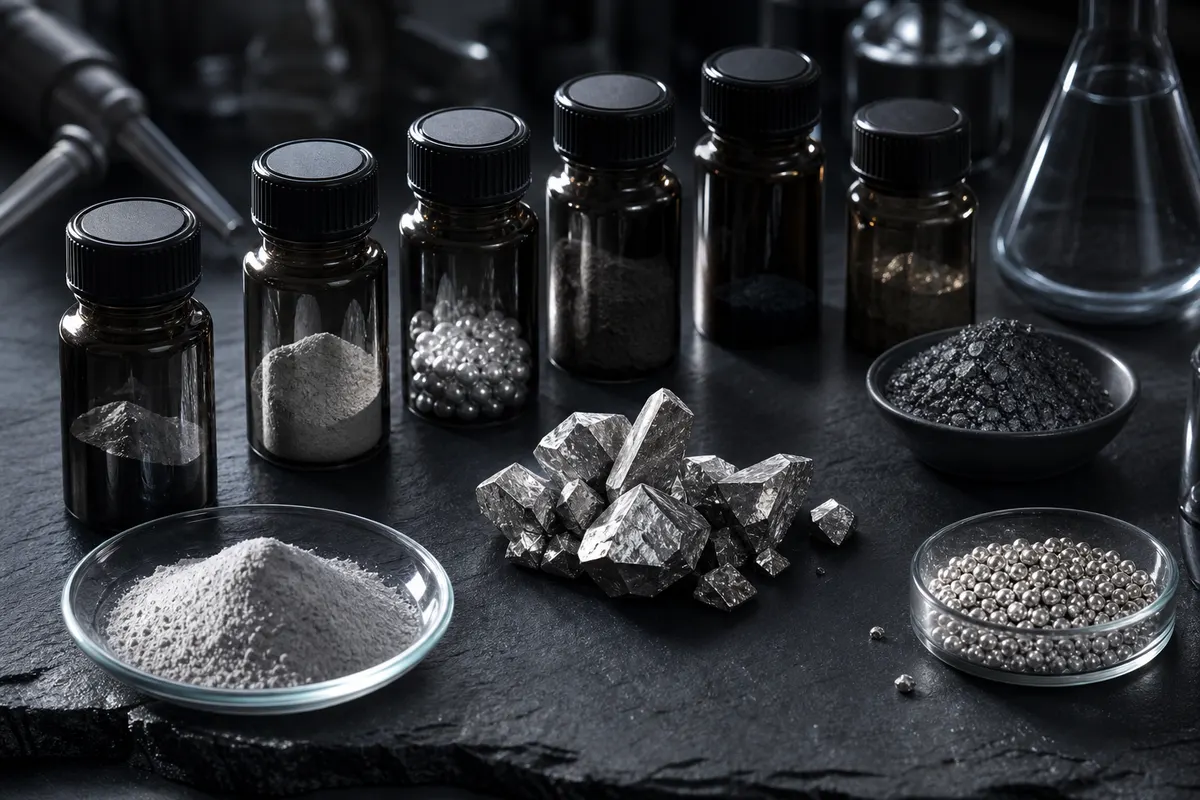
Industrial silver compounds form a vast world beyond pure metallic silver. From silver nitrate (AgNO₃), the most produced compound, to silver oxide (Ag₂O), silver chloride (AgCl), nano-silver, and silver halides — each has unique chemical and physical properties essential for specific applications. Understanding these compounds is critical for industrial buyers, chemical engineers, and suppliers such as Bazaarnoghre at the base of the silver supply chain.
Classification of Silver Compounds
Silver compounds can be classified by bond type and application:
Inorganic compounds: nitrates, oxides, chlorides, bromides, iodides, sulfides, cyanides, and phosphides of silver.
Organic compounds: silver acetate, silver lactate, and organic silver complexes.
Nano-silver: silver particles 1 to 100 nanometers with antibacterial and high conductivity properties.
Colloidal silver: stable silver particles in solution (historically used in photography).
Most Important Industrial Silver Compounds
Silver Nitrate (AgNO₃)
The most produced silver compound. Precursor for catalysts, mirror making, plating, and synthesis of other compounds. Details in ../silver-nitrate-production/.
Silver Oxide (Ag₂O)
Brown-black solid, soluble in nitric acid. Used in silver-zinc batteries (legacy), oxygen sensors, and some catalysts. Produced by reacting NaOH with AgNO₃.
Silver Chloride (AgCl)
White insoluble precipitate, light-sensitive (photography base). Today used in reference electrodes, photochromic glass, and some sensors.
Nano-Silver (Ag NPs)
One of the fastest-growing segments. Produced by reducing silver nitrate (Lee-Meisel or Turkevich method). Used in wound dressings, antibacterial coatings, conductive inks, and biosensors.
Silver Cyanide (AgCN) and Silver Thiocyanate
Used in silver plating baths. AgCN is highly toxic and requires strict safety management.
Table: Industrial Silver Compounds and Applications
| Compound | Formula | Main Application | Hazard |
|---|---|---|---|
| Silver nitrate | AgNO₃ | Catalyst, mirror, plating | Oxidizer, toxic |
| Silver oxide | Ag₂O | Battery, sensor, catalyst | Environmental |
| Silver chloride | AgCl | Reference electrode, photography | Low |
| Nano-silver | Ag (nano) | Medical, coating, ink | Environmental |
| Silver cyanide | AgCN | Silver plating | Highly toxic |
| Silver acetate | CH₃COOAg | Analysis, coating | Moderate |
| Silver powder | Ag (powder) | Electronic paste, MLCC | Combustible |
Methods of Producing Silver Compounds
Most silver compounds are synthesized from pure metallic silver or silver nitrate. Typical path: 999.9 silver bar → silver nitrate → target compound. For nano-silver, chemical reduction of AgNO₃ with sodium borohydride or glucose in the presence of a stabilizer polymer. Particle size, distribution, and surface coating control are critical for medical and electronics applications.
Standards and Certifications
Industrial silver compounds must meet various standards: ACS for laboratory grade, ISO and ASTM for industrial grade, REACH and OSHA for safety, GMP for pharmaceutical use. CoA for each batch must include purity percentage, metal impurities, and physical specifications.
Recycling and Sustainability
Silver in industrial compounds is often recovered after use. Spent catalyst, plating waste, and electronic scrap are silver recovery sources. Silver recovery rates are among the highest of any metal (over 90%). This makes silver attractive from a circular economy perspective.
Choosing the Right Compound for Each Industry
Petrochemical industry: silver nitrate → catalyst (../silver-catalyst-industry/, ../silver-ethylene-oxide/). Electronics: silver powder and paste. Medical: nano-silver with GMP certification. Mirror and glass: silver nitrate. Plating: AgCN or AgNO₃. Wrong grade or compound choice can jeopardize final product quality.
Silver Compounds in Textiles and Apparel
Nano-silver in textile fibers provides antibacterial and odor-control properties. Diabetic socks, sportswear, and hospital curtains use this technology. Oeko-Tex and REACH set limits on silver content in textile products.
Silver Compounds in Photography and Optics
Although analog photography is largely obsolete, some specialized uses of silver halides (AgBr, AgCl) remain in radiographic film, industrial light sensitivity, and holography.
Primary Material Supply from Bazaarnoghre
All industrial silver compounds ultimately derive from pure metallic silver. Bazaarnoghre supplies 999.9 silver bars, shot, and industrial silver with assay certificates — a solid base for AgNO₃, nano-silver, and hundreds of other compound producers. For ../../../index.html#products, ../../../index.html#contact consultation, and the ../ chemical industry hub.
Silver Compounds in Water Treatment and Environment
Silver nitrate and nano-silver are used in water purification filters for disinfection without chlorine. ISS systems use silver for drinking water. Environmental limits on silver ion discharge in wastewater exist in some countries; recovery from industrial effluent is economical.
Silver Halides and Specialized Applications
Beyond AgCl and AgBr in photography, silver iodide (AgI) is used in cloud seeding and silver bromide in some catalysts. Silver sulfide (Ag₂S) is corrosion product but is deliberately produced in some sensors.
Global Market for Silver Compounds
The industrial silver compounds market is worth billions of dollars. Catalysts hold the largest share, followed by plating, nano-silver, and electronics. Nano-silver in medicine and consumer goods is one of the fastest-growing segments.
Buying Silver Compounds for Industry
Industrial buyers should consider SDS, CoA, proper packaging, and authorized transport beyond price. For nano-silver, particle size specs (DLS, TEM) and total metal concentration must be in the spec. Annual supply contracts with min-max orders make cash flow predictable.
Regulation of Silver Compounds in Europe and the USA
REACH in the EU requires registration and assessment of chemicals including silver compounds. EPA sets limits on silver in drinking water and wastewater. Nano-silver producers must prepare safety dossiers.
Outlook for Silver Compound Demand
Analysts expect catalysts to remain the largest consumer, with faster growth from nano-silver in medicine, electronics, and consumer goods. For Iranian producers, exporting quality silver compounds with international standards is a regional market opportunity.
Laboratory and Quality Control of Compounds
Production labs use titration, gravimetry, ICP-OES, ICP-MS, and for nano-silver DLS and TEM. Rejected batches must not return to market without rework or authorized disposal. ISO 17025 is recommended for reference labs.
Partnership with a trusted primary silver supplier like Bazaarnoghre is a reliable base for consistent-quality silver compound production.
Archive sample retention from each compound batch for the contract period is critical for quality complaint resolution.
Silver compound product catalogs often include dozens of SKUs; selection with supplier technical consultation reduces purchase errors.
Deep understanding of each compound and its application helps industrial buyers optimize cost without sacrificing quality.
Conclusion: industrial silver compounds bridge metallic silver and hundreds of specialized applications — and their quality begins with primary silver quality.
Further reading
Related articles
To view 999.9 fine silver products, visit the Bazaarnoghre products page.