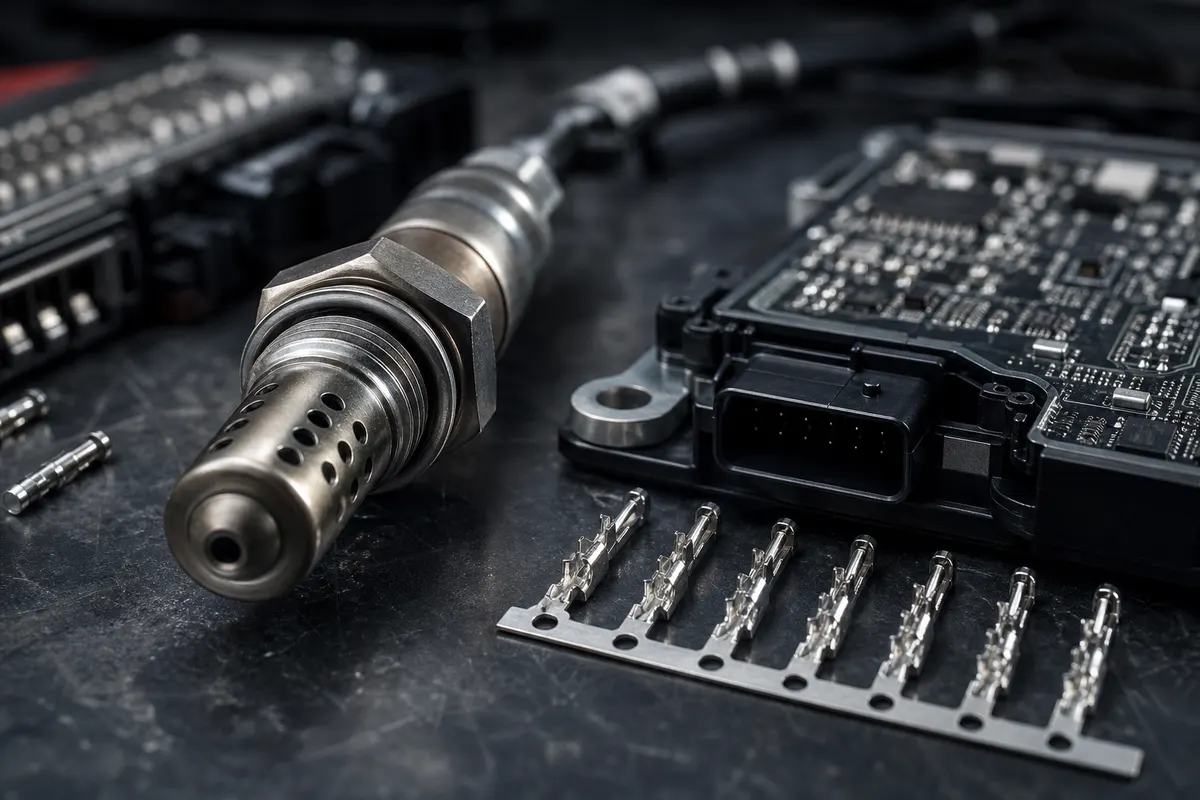
The automotive sensor is the eyes and ears of a vehicle's electronic systems, and silver plays a key role in many of them. The most important is the oxygen sensor (O2 or lambda sensor), with at least two — and up to four in newer cars — per ICE vehicle. Silver electrodes measure exhaust oxygen and feed the ECU (engine control unit) to optimize the air-fuel ratio.
Oxygen sensor: heart of emissions control
O2 sensors have been used since the 1970s and are mandatory for Euro 6 and EPA standards. Zirconia (ZrO2) sensors have silver electrodes on both sides of the ceramic. Silver acts as catalyst and electrode conductor. Each O2 sensor holds about 0.5 to 1 gram of silver and lasts 100,000 to 160,000 km.
As the sensor wears, engine efficiency drops and fuel use and emissions rise. The global O2 sensor market exceeds 100 million units per year — significant silver consumption.
Temperature and pressure sensors
Coolant, oil, intake, and exhaust temperature sensors use silver contacts to transfer signals. Pressure sensors (MAP, barometric, fuel pressure) also have silver connections. In HVAC, ambient temperature and humidity sensors connect to the ECU via silver contacts.
Signal accuracy and stability from -40 to +150°C under vibration and moisture require high conductivity and oxidation resistance — two hallmark silver properties.
Safety and SRS sensors
The airbag system (SRS) has crash sensors (accelerometers) and control modules that must react in milliseconds. These life-critical connections use silver for 100% reliability. ABS and ESP sensors also have silver contacts.
Sensors in electric vehicles
EVs add dedicated sensors beyond those shared with ICE: cell temperature, BMS current sensors, state-of-charge sensors, and HV safety sensors. Each battery module has dozens of temperature sensors with silver connections.
ADAS (advanced driver assistance) includes radar, lidar, camera, and ultrasonic sensors. Although the sensors themselves are mainly silicon and semiconductors, PCBs and internal connections use silver.
Production process and quality
Silver O2 electrode production involves silver powder compaction, sintering, and mounting on zirconia ceramic. Silver purity directly affects sensor sensitivity and life. Impurities can cause signal drift and shorter life. Sensor makers use 999.9 silver with precise specs.
Bazaarnoghre supplies industrial silver and granules with guaranteed purity for the parts industry. See ../../../index.html#products.
| Sensor type | Silver role | Count per vehicle | Silver (g/unit) |
|---|---|---|---|
| Oxygen (O2) | Main electrode | 2–4 | 0.5–1 |
| Temperature | Signal contact | 5–15 | 0.01–0.1 |
| Pressure | Contact | 2–5 | 0.05–0.2 |
| Crash (SRS) | Module connection | 3–8 | 0.1–0.5 |
| Battery (BMS) | Current & temp sensors | 10–50+ | 0.01–0.1 |
Emissions standards and the future
Euro 7 and EPA Tier 3 are stricter and require more precise sensors. Plug-in hybrids may need fewer O2 sensors but more battery sensors. Long term, full BEVs eliminate O2 sensors but new sensors replace them.
Maintenance and replacement
A worn O2 sensor is a common cause of the Check Engine light. Drivers often replace it after 100,000 km. The global O2 aftermarket exceeds $5 billion annually. Counterfeit sensors with poor silver electrodes have shorter life and lower accuracy — raising fuel use and emissions.
Mechanics and workshops should use genuine sensors with quality silver electrodes. Aftermarket makers using 999.9 silver from trusted sources earn market trust.
OBD standards and diagnostics
OBD-II has been mandatory in the US since 1996 and Europe since 2001. The O2 sensor sends lambda data to the ECU; faults store DTC codes. Codes P0130–P0167 relate to oxygen sensors. Sensor accuracy is critical for MOT and EPA tests.
For broader silver uses in vehicles, read ../silver-automotive-applications/. Inquiry ../../../index.html#contact and articles at ../.
Guide to silver supply for automotive sensor industry
Sensor industry procurement faces: price volatility, 999.9 purity requirements, export documentation, and import competition. A trusted domestic supplier with lab certificates, batch traceability, and on-time delivery reduces production risk.
Bazaarnoghre supplies 999.9 ingots, granules, and industrial silver. Benefits include XRF/ICP-MS certificates, batch traceability, transparent pricing, Tehran delivery, free consultation, and long-term contracts.
Review ../../../index.html#products before ordering. Pricing and CoA at ../../../index.html#contact. More at ../.
Industrial FAQ about 999.9 silver
Manufacturers ask: ingot vs granule? Ingots for melting; granules for casting. 999.9 vs 999? 999.9 is more precise. Verify authenticity with XRF and batch CoA match. Bazaarnoghre provides certificates. Compare at ../../../index.html#products.
Industrial FAQ about 999.9 silver
Manufacturers ask: ingot vs granule? Ingots for melting; granules for casting. 999.9 vs 999? 999.9 is more precise. Verify authenticity with XRF and batch CoA match. Bazaarnoghre provides certificates. Compare at ../../../index.html#products.
Industrial FAQ about 999.9 silver
Manufacturers ask: ingot vs granule? Ingots for melting; granules for casting. 999.9 vs 999? 999.9 is more precise. Verify authenticity with XRF and batch CoA match. Bazaarnoghre provides certificates. Compare at ../../../index.html#products.
Conclusion
Automotive sensors need silver for required efficiency and safety. From emissions control to occupant safety, silver electrodes and contacts operate at thousands of points in every vehicle. Raw silver quality determines sensor accuracy and durability.
Further reading
Related articles
To view 999.9 fine silver products, visit the Bazaarnoghre products page.