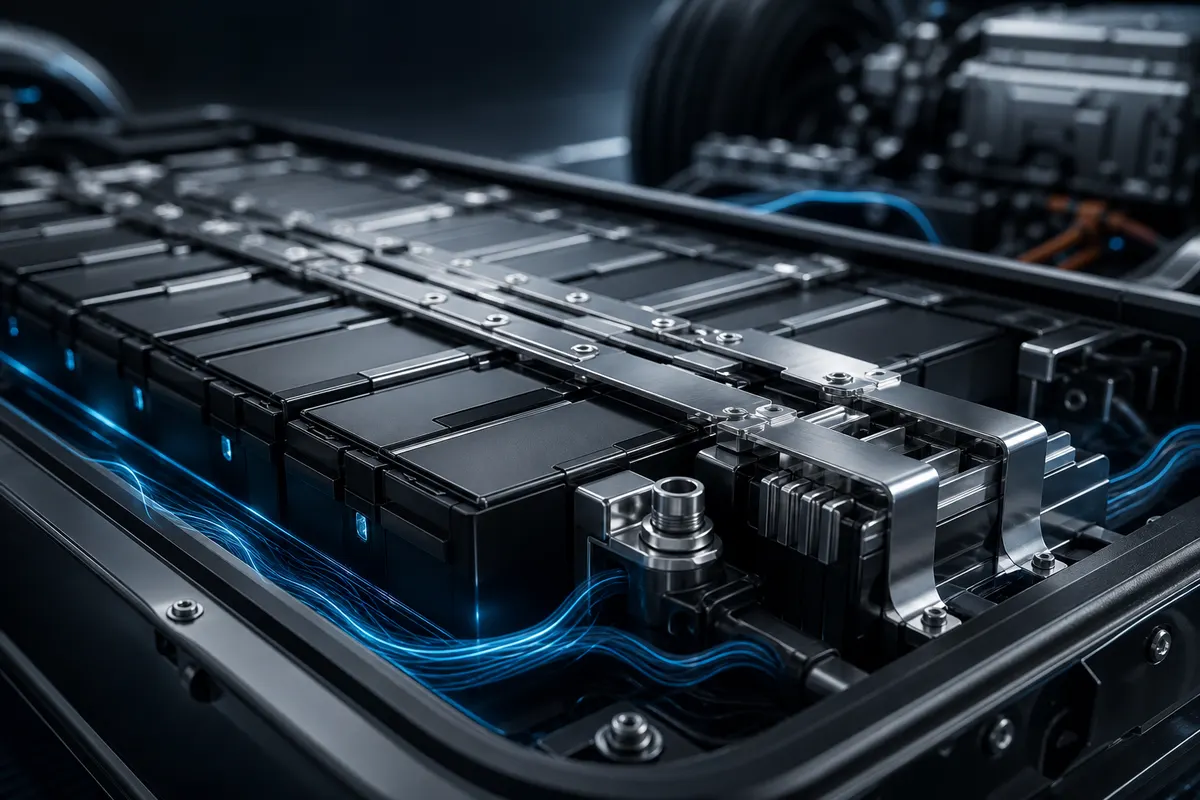
Silver in electric vehicles (EVs) is one of the most important drivers of industrial silver demand in the 2020s. A battery electric vehicle (BEV) uses on average 25 to 50 percent more silver than an equivalent ICE vehicle. This increase comes from more complex electrical systems, lithium-ion batteries, power inverters, onboard chargers, and charging infrastructure. Analysts forecast that by 2030 the EV industry alone will consume more than 90 million ounces of silver per year.
Battery and thermal management
Although the lithium-ion cell itself is mainly lithium, cobalt, nickel, and manganese, the battery management system (BMS) and internal battery connections use silver. Silver bus bars inside battery modules carry high currents (up to 400 A in performance vehicles) with minimal heat loss. Each kWh of battery capacity needs roughly 0.5 to 1 gram of silver in connections.
Battery cooling systems also have sensors and electric valves with silver contacts. As battery capacity grows (from 60 kWh to 100+ kWh in new models), silver use in this segment increases.
Inverter and electric motor
The power inverter converts DC from the battery to AC for the motor. This happens at high frequency and current, and internal inverter connections are made of silver or silver alloys. Power IGBTs and MOSFETs in the inverter need silver bonding strips to minimize heat loss.
Sync or async electric motors have windings that in some designs use silver wire or silver coating. Higher motor power means higher conductivity needs and more silver consumption.
Onboard charger and fast charging
The onboard charger (OBC) converts grid AC to battery DC. 11 kW, 22 kW, and even 43 kW chargers in new vehicles have many silver contacts and connections. DC fast charging (up to 350 kW) at charging stations also uses heavy silver contacts. CCS and CHAdeMO standards both depend on high-conductivity connections.
Advanced electronics and autonomy
EVs typically have more advanced electronics than ICE vehicles: large displays, ADAS (advanced driver assistance), 5G connectivity, and OTA updates. Each system has hundreds of silver contacts and connections. Future autonomous vehicles with lidar, radar, and multiple cameras will further increase silver consumption.
Automotive electronics manufacturers need 999.9 silver for contacts and bonding strips. Bazaarnoghre supplies this raw material with purity certificates.
Consumption comparison: ICE vs EV
The table below shows approximate silver use by vehicle type based on industry reports.
| Vehicle type | Silver use (g) | Top consumer | Trend |
|---|---|---|---|
| ICE | 15–20 | Relays & wiring | Declining |
| Hybrid (HEV) | 25–35 | Battery + relays | Stable |
| Electric (BEV) | 50–80 | Battery + inverter + charging | Rapid growth |
| Autonomous | 80–120+ | Sensors + electronics | Emerging |
Impact on the silver market and investment
The shift to EVs is one of the main factors driving industrial silver demand growth. The IEA forecasts that by 2030, 60% of new vehicle sales globally will be electric. This transition increases pressure on silver supply. Miners and refiners are expanding capacity but may not keep pace with demand.
For Iran's parts industry this is both opportunity and challenge. Domestic automakers are developing EVs and need stable industrial silver supply. Bazaarnoghre covers this need via ../../../index.html#products and ../../../index.html#contact.
Emerging technologies
Solid-state batteries under development may need different silver connections. Wireless vehicle charging (WPT) also uses silver contacts in energy transfer systems. The 800-volt architecture adopted by Tesla, Porsche, Hyundai, and others carries higher currents and greater need for silver conductivity.
Charging infrastructure and the grid
EV growth requires broad charging infrastructure. DC fast-charging stations at 150 to 350 kW use heavy silver contacts to connect the charger to the vehicle. Each fast-charge session passes high currents through these contacts, making silver conductivity and durability critical. Urban distribution grids upgrading for millions of EVs also use silver contacts in transformers and network switches.
In Iran, EV charging infrastructure development is underway. Domestic automakers such as Iran Khodro and Saipa are developing electric platforms, and parts suppliers should prepare silver supply chains for this transition now.
Silver recycling from end-of-life vehicles
As the EV fleet grows, recycling batteries and precious metals matters more. Silver in relays, sensors, wiring, and electronics is recoverable. The EU mandates precious-metal recycling under ELV (End-of-Life Vehicles) rules. Each scrapped vehicle holds 15 to 80 grams of silver recoverable with proper processes.
For the long-term outlook, read ../silver-automotive-future/. More automotive articles: ../.
Guide to silver supply for the EV industry
EV procurement managers face multiple challenges: global silver price volatility, consistent 999.9 purity, export documentation, and import competition. A trusted domestic supplier with lab certificates, batch traceability, and on-time delivery greatly reduces production risk.
Bazaarnoghre supplies 999.9 silver ingots, granules, and industrial silver for Iranian industries. Benefits include:
- Assay certificates with XRF and ICP-MS analysis
- Batch numbers and origin traceability
- Transparent global-market pricing
- Delivery in Tehran and nationwide shipping
- Free technical consultation
- Long-term supply contracts with fixed or formula pricing
Review ../../../index.html#products before ordering. For daily pricing and CoA samples use ../../../index.html#contact. More articles at ../.
Industrial FAQ about 999.9 silver
Manufacturers typically ask: What is the difference between ingots and granules? Ingots for melting and alloying; granules for casting with uniform grain. Is 999.9 different from 999? Yes — 999.9 is more precise for sensitive uses. How to verify authenticity? XRF or independent lab and batch match to CoA.
Bazaarnoghre provides purity certificates and can send samples to customer labs. Compare at ../../../index.html#products.
Summary
The electric vehicle has turned silver from a hidden component into a strategic material. Battery, inverter, charging, and advanced electronics each account for significant silver use. Suppliers and automakers who secure silver supply chains will have a competitive edge.
Further reading
Related articles
To view 999.9 fine silver products, visit the Bazaarnoghre products page.