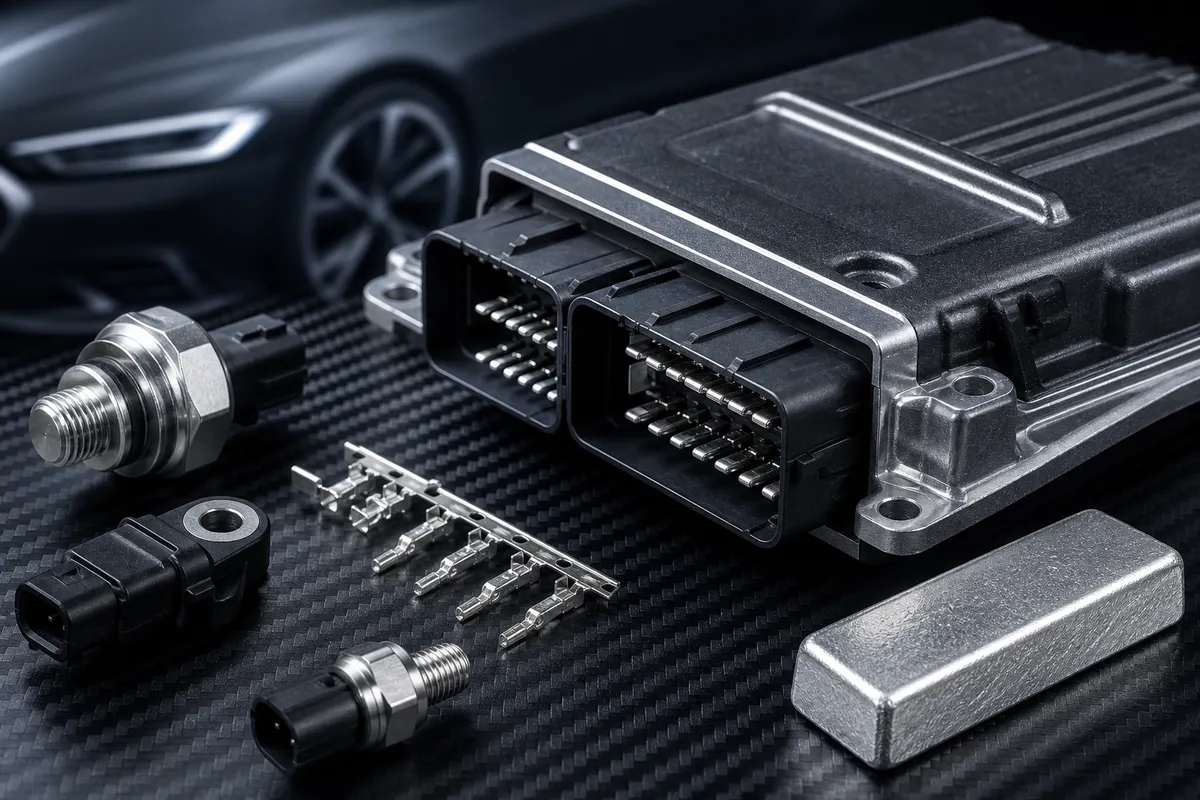
Silver in the automotive industry is one of the most hidden yet critical uses of this precious metal. Every modern vehicle — from an economy sedan to a luxury SUV — contains dozens of grams of silver, mainly in electrical and electronic systems. Silver's electrical conductivity is 106% of copper (IACS basis) and it is the only metal that outperforms copper at room temperature. Together with oxidation resistance and weldability, these properties make silver the first choice for sensitive contacts and high-current wiring. The global automotive industry consumes more than 50 million ounces of silver annually.
Electrical contacts and relays
The largest silver use in vehicles is relay and switch contacts. A typical car contains 30 to 50 relays, each with silver or silver-cadmium contacts. Contacts must carry high currents without excessive heating and resist arcing. With a melting point of 961°C and exceptional conductivity, silver meets these requirements.
In HVAC, heater, lighting, wiper, and power-seat systems, silver relays operate thousands of times over the vehicle's life. Silver alloy quality — usually silver with cadmium, nickel, or copper — directly affects contact life. Raw 999.9 silver with high purity is the base for producing these alloys.
Wiring and bonding strips
Although copper forms the main vehicle wiring, silver wire or silver-plated strips are used where high current or limited space matters. Battery charging, starter, and alternator systems use silver connections. Silver does not form non-conductive oxide — unlike copper, which builds a resistive oxide layer — ensuring stable electrical connection.
In luxury and sports cars, silver wiring reduces weight and improves electrical efficiency. Every gram saved matters in automotive engineering, and silver's higher conductivity allows thinner wire than copper for the same current.
Diffusers and interior mirrors
Folding mirrors and in-cabin diffusers are often coated with a thin silver layer. PVD (physical vapor deposition) or electroplating provides high reflectivity and durability. Silver use in this segment is lower than in contacts but significant at millions of vehicles per year.
HVAC and temperature control systems
Electric HVAC valves use silver contacts for fast switching. Temperature and pressure sensors also have silver connections. As automated cabin systems grow in new vehicles, silver consumption points are increasing.
Bazaarnoghre supports the domestic supply chain by supplying industrial silver and silver granules to automotive parts manufacturers. See ../../../index.html#products for products.
Consumption statistics and market trends
According to the Silver Institute, a typical ICE vehicle uses about 15 to 20 grams of silver. Hybrids raise this to 25–35 grams, and battery electric vehicles (BEVs) may need 50 to 80 grams. As the global fleet electrifies, automotive silver demand will grow sharply over the next decade.
China is the world's largest vehicle producer and consumer, and Chinese automotive silver demand affects global prices. Iran, with an active auto industry, is an important regional consumer.
| Vehicle area | Silver application | Approx. use (g) |
|---|---|---|
| Relays & switches | Silver contacts | 8–15 |
| Wiring & connections | Silver wire & strip | 3–8 |
| Sensors | Electrodes & contacts | 2–5 |
| Mirrors & trim | Silver coating | 1–3 |
| Audio systems | Contacts & EMI shielding | 1–2 |
Supply challenges for Iran's industry
Iran's automotive parts sector depends on imported raw materials. Global silver price volatility and sanctions complicate production planning. Domestic industrial silver supply with stable pricing and purity certificates reduces supply-chain risk. Bazaarnoghre, offering 999.9 ingots and granules, is a reliable option for parts makers.
Impact on pricing and part design
Silver prices have fluctuated significantly in recent years, directly affecting the cost of automotive electrical parts. During design, engineers optimize contact thickness and alloy choice to minimize silver use without compromising electrical reliability. Techniques such as selective plating (coating only the contact point instead of the full surface) yield substantial savings.
Major OEMs such as Toyota, Volkswagen, and GM sign long-term contracts with silver suppliers and tier-1 parts makers to manage price volatility. In Iran, parts suppliers who secure silver supply through a trusted domestic source like Bazaarnoghre gain an advantage in negotiations with automakers.
For silver's role in electric vehicles, read ../silver-electric-vehicles/. Request pricing at ../../../index.html#contact and browse more automotive articles at ../.
Guide to silver supply for the automotive industry
Procurement managers in automotive face multiple challenges: global silver price volatility, consistent 999.9 purity requirements, export documentation, and competition with imports. Choosing a trusted domestic supplier offering lab certificates, batch traceability, and on-time delivery greatly reduces production risk.
Bazaarnoghre specializes in 999.9 silver ingots, granules, and industrial silver for Iranian industries. Benefits of working with Bazaarnoghre include:
- Assay certificates with XRF and ICP-MS analysis
- Batch numbers and origin traceability for every ingot
- Transparent pricing based on global markets
- Delivery in Tehran and nationwide shipping
- Free technical consultation on product selection
- Long-term supply contracts with fixed or formula pricing
Before ordering, review ../../../index.html#products. For daily pricing and CoA samples, use ../../../index.html#contact. More specialized articles in this field are available at ../.
Industrial FAQ about 999.9 silver
Professional manufacturers typically ask before buying industrial silver: What is the difference between ingots and granules? Ingots are for melting and alloying; granules for casting with uniform grain size. Is 999.9 different from 999? Yes — 999.9 is more precise and recommended for sensitive applications. How do I verify authenticity? Use XRF or an independent lab and match batch numbers to the CoA.
Bazaarnoghre provides a purity certificate for every order and can send samples to the customer's lab. Compare products at ../../../index.html#products.
Conclusion
Silver sits at the heart of every vehicle's electrical systems. From small relays to high-current wiring, silver's conductivity and durability have no substitute. As the global fleet electrifies, this metal's importance in automotive will only grow.
Further reading
Related articles
To view 999.9 fine silver products, visit the Bazaarnoghre products page.