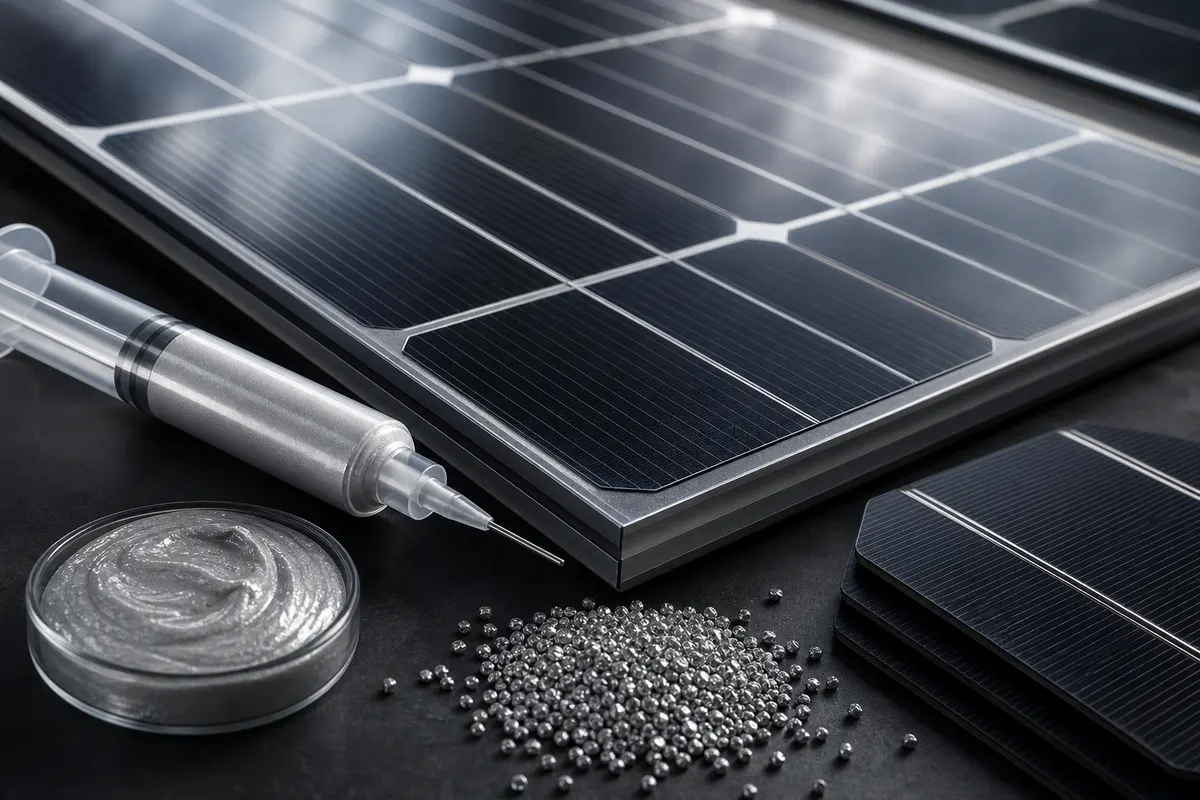
Silver in solar panels is one of the most important factors determining photovoltaic efficiency and production cost. Each silicon solar cell needs a network of thin conductive lines to transfer electrons generated under sunlight to external terminals — usually made from silver paste. Industry estimates suggest a typical 60-cell residential panel may consume 5 to 8 grams of silver, and the global solar industry uses more than 140 million ounces annually — placing it alongside electronics as the largest segment of industrial silver demand.
What Does Silver Do in a Solar Cell?
When solar photons strike a silicon cell, electron-hole pairs form. Free electrons must be collected at the electrode before recombination. Thin silver lines on the front surface (front busbars and finger lines) provide this path with minimum resistance. The higher the line resistance, the greater the power loss and the lower the panel efficiency. Silver's unmatched conductivity among metals makes it the unavoidable choice.
Types of Silver Paste in Solar Technologies
Solar cell technology has transformed over two decades and silver paste requirements have changed accordingly. In older BSF cells, simpler paste sufficed. In PERC (Passivated Emitter and Rear Cell) cells, paste must be compatible with the rear passivation layer. TOPCon and HJT (Heterojunction) technologies require paste with lower sintering temperature and better adhesion to oxide surfaces. Paste producers such as Heraeus, DuPont, and Giga Solar invest millions in R&D to optimize formulations based on silver powder quality.
Front-Side and Back-Side Paste
Front-side paste forms the current collection grid and must balance high conductivity with minimal surface coverage (to avoid shading). Back-side paste in bifacial and PERC cells connects the rear electrode. Both require 999.9 silver with uniform particle distribution.
Silver Consumption per Watt
Industry trends show silver consumption per watt is declining — from about 500 mg/W in 2010 to near 100 mg/W in 2024. This reduction (silver thrifting) results from fine-line printing, fewer busbars, and multi-busbar and SMBB technologies. However, as hundreds of gigawatts of solar capacity are installed worldwide each year, absolute silver demand continues to rise.
Table: Silver Consumption by Panel Type
| Cell/Panel Type | Approx. Silver (g/60-cell panel) | Dominant Technology | Consumption Trend |
|---|---|---|---|
| Standard polycrystalline | 4–5 g | BSF | Exiting market |
| Mono PERC | 5–7 g | PERC | High market share |
| Mono TOPCon | 6–8 g | N-type | Rapid growth |
| HJT / glass-glass | 7–10 g | Heterojunction | Premium, growing |
| Bifacial panel | 8–12 g | PERC/TOPCon | Higher back-side use |
Impact of Silver Price on the Solar Industry
Silver accounts for about 5 to 10 percent of a solar module's raw material cost. LME price volatility can pressure manufacturer margins. Some companies are testing alternatives such as copper with silver plating or aluminum-based electrodes, but in high-efficiency applications silver remains the winner. Raw material suppliers such as Bazaarnoghre, offering 999.9 silver and long-term contracts, help paste and module producers plan costs more accurately.
Silver Supply Chain for Solar
The chain starts with silver extraction (mine or as byproduct from copper, lead, and zinc), then refining to 999.9 ingots, powder production, paste manufacturing, and finally printing on cells. Each link determines quality. Improper silver powder particles cause printing defects (bridging, breakage) and efficiency loss. Industrial buyers can use ../../../index.html#products from Bazaarnoghre for powder production raw material. Details on silver electronics applications are in ../silver-electronics-applications/ and conductivity in ../silver-electrical-conductor/.
Cell Technology Impact on Silver Consumption
Migration from p-type polycrystalline to n-type monocrystalline has increased cell efficiency and changed paste requirements. TOPCon cells with thin silicon oxide surface layers need paste with lower sintering temperature (600–750°C versus 800+ for PERC). This affects paste formulation but silver remains the primary conductive material. HJT glass-glass cells need more bilateral paste and increase silver per cell. Paste and powder producers must keep pace with these technology shifts.
Silver Recycling from End-of-Life Panels
As first-generation solar panels reach end of life (25–30 years), recycling silver from worn modules gains economic and environmental importance. Mechanical (crushing and separation) and chemical (dissolving conductive layers) processes recover silver. Recovery rates from end-of-life panels are improving and by 2030 may become a significant silver supply source. However, new demand continues to be met by mass production of fresh panels.
Future: Less Silver or More Panels?
Forecasts suggest silver per watt will continue declining through 2030, but with more than 500 GW installed annually, total demand may double. Silver-free technologies (such as some experimental perovskite cells) have not yet reached mass production. For regional producers, access to consistently quality silver from a trusted supplier like Bazaarnoghre is a competitive advantage in module exports. For consultation see ../../../index.html#contact and more at ../.
Iran and the Region in the Solar Chain
Iran and regional countries with high solar irradiance are developing production and installation capacity. Cell and module factories need stable supply of quality silver powder and paste. Dependence on imported silver paste pushes domestic producers toward localization or contracts with reputable international suppliers. Bazaarnoghre, supplying 999.9 primary silver, can strengthen part of this chain domestically and reduce ingot import dependence.
Paste Printing on the Production Line
In solar cell factories, silver paste printing is one of the most sensitive steps. Silicon cells reach the screen printer after etching and passivation. A metal mesh with micrometric openings passes paste and forms finger and busbar patterns on the surface. Alignment accuracy, paste viscosity, print speed, and squeegee-to-mesh distance affect print quality. Common defects include bridging between lines, finger breakage, and thickness non-uniformity — each reducing efficiency. Controlling initial silver powder quality is the first line of defense against these problems.
Global Paste Producer Competition
The solar silver paste market is dominated by chemical giants such as Heraeus (Germany), DuPont (USA), Giga Solar (Taiwan), and Samsung SDI (Korea). These companies contract directly with silver powder producers and conduct joint R&D. Chinese cell producers such as LONGi and JA Solar consume massive paste volumes, increasing price pressure on the silver supply chain.
Module producers sometimes invest directly in silver powder production lines to reduce paste import dependence — but this requires stable access to competitively priced 999.9 ingots. Bazaarnoghre can be a supply partner at the first chain stage, before powder production and paste formulation, facilitating production planning with regular delivery and purity certificates.
Conclusion: silver in solar panels is irreplaceable in current technology, and its quality directly affects every watt you generate from the sun.
Further reading
Related articles
To view 999.9 fine silver products, visit the Bazaarnoghre products page.