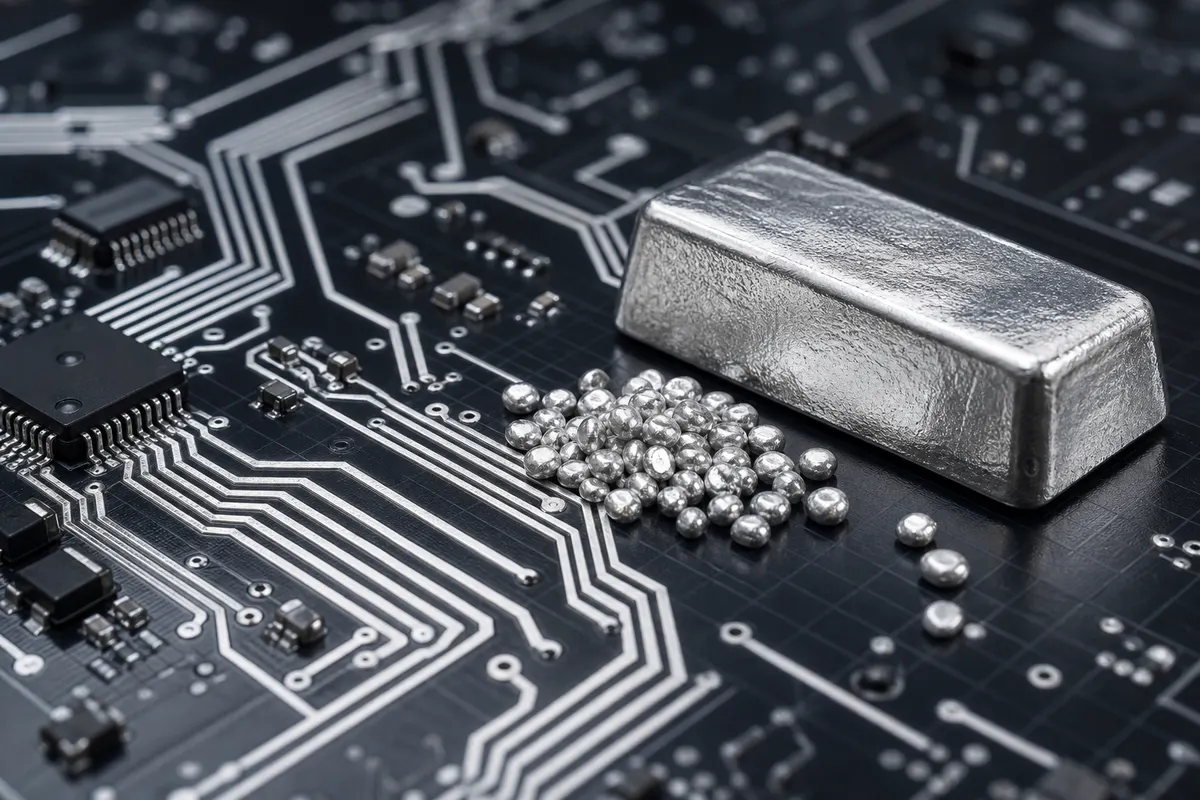
In today's world, silver in electronics is far more than a simple technical choice; with electrical conductivity of approximately 106% IACS (relative to copper reference) and excellent electrical contact stability, silver sits at the heart of nearly every electronic device we use daily. From smartphones and laptops to telecom equipment and industrial control systems, silver is consumed as a conductive layer, contact plating, and conductive powder raw material in printed circuit boards (PCBs). Estimates show more than 300 million ounces of silver are consumed annually in electronics and solar energy industries, and this figure continues to rise with the expansion of 5G, IoT, and electric vehicles.
Why Is the Electronics Industry Dependent on Silver?
When designing circuits, electronics engineers seek the lowest electrical resistance, minimum heat loss, and maximum contact reliability. Silver leads in all three criteria. Silver's electrical conductivity is about 6% higher than copper and performs better at high frequencies as well. Furthermore, silver oxide (Ag₂O), unlike aluminum or copper oxide, remains a suitable electrical conductor — a property that is critical in relay contacts and switches that open and close millions of times. For industrial suppliers such as Bazaarnoghre, providing 999.9 silver with assay certificates ensures consistent quality across the electronics supply chain.
Silver in Printed Circuit Boards (PCB)
One of the highest-volume uses of silver in electronics is silver paste for printing conductive traces on printed circuit boards. In PERC and TOPCon solar cell technology and in high-density multilayer PCBs, silver paste with nanometric particles is printed onto silicon or substrate surfaces and, after sintering, creates a conductive layer with very low resistance. Silver powder quality — particle size, distribution, and purity — directly affects final circuit performance. Electronics companies using ../../../index.html#products from Bazaarnoghre have access to consistent purity and batch-to-batch traceability.
Types of Silver Paste in Industry
Front-side pastes for current collection in solar cells, back-side pastes for rear electrode connection, and die-attach pastes for bonding chips to substrates are the main types. Each has a different formulation but all require high-quality pure silver.
Silver in Contacts, Relays, and Switches
In industrial electrical equipment and automotive applications, silver contacts or silver-alloyed contacts (AgCdO, AgSnO₂) operate millions of cycles without significant contact resistance degradation. Protective relays, power switches, and motor contactors use silver to carry currents of several hundred amperes. Read more about this area in the article ../silver-contacts-switches/.
Silver in RFID, Antennas, and 5G Telecom
RFID tags, printed antennas, and microwave filters use thin silver layers. In 5G and mmWave networks, signal loss must be minimized and silver is chosen as the conductor with the lowest surface resistance (considering the skin effect at high frequency). Demand for silver in telecom infrastructure has been one of the main drivers of industrial silver consumption growth over the past decade.
Silver in Power Electronics and Electric Vehicles
Electric vehicle inverters, fast chargers, and IGBT modules use silver contacts and silver bonding layers. As 800-volt systems increase in next-generation vehicles, the need for high conductivity and thermal stability grows. In these applications, silver is often used as sheet, bonding wire, or electroplating coating.
Comparison Table: Silver Applications in Electronics
| Application | Silver Form | Typical Purity | Technical Priority |
|---|---|---|---|
| PCB & printed circuits | Paste, powder | 999 to 999.9 | Conductivity, adhesion |
| Contacts & relays | Sheet, AgSnO₂ alloy | 999+ | Wear resistance, anti-oxidation |
| RFID & antennas | Thin coating, conductive ink | 999.9 | Low surface resistance |
| Power electronics | Bonding wire, sheet | 999.9 | Conductivity, thermal conductivity |
| Solar cells | Front/back paste | 999.9 | Printability, low loss |
Supply Challenges and Supplier Selection
Silver price volatility on global markets (LME and COMEX) directly affects electronics production costs. Beyond price, quality consistency, purity certificates, anti-oxidation packaging, and on-time delivery are key supplier selection criteria. Bazaarnoghre supplies ingots, granules, and industrial 999.9 silver, covering the needs of electronics factories and paste producers. For price quotes and technical consultation, use ../../../index.html#contact.
Silver in Chip Packaging and Wire Bonding
In the semiconductor industry, silver bonding wire connects chip pads to lead frame pins or substrates. Wire diameter is typically 15 to 50 microns and billions of connections are made annually in OSAT (Outsourced Semiconductor Assembly and Test) factories. Silver is chosen for bonding because of high conductivity, mechanical flexibility, and compatibility with soldering processes. In some sensitive applications, silver-palladium (Ag-Pd) alloys are used for sulfur corrosion resistance. Bonding wire quality depends on initial silver purity and absence of oxygen-seeking impurities such as lead and bismuth.
Silver in Multilayer Ceramic Capacitors (MLCC)
MLCCs, present in dozens to thousands on every electronic board, use internal silver electrodes. Nanometric silver powder forms electrode layers and, after sintering, creates a conductive network with very low resistance. Growth in the 5G, electric vehicle, and IoT markets has increased MLCC and consequently silver powder demand. Silver powder producers require 999.9 raw material with uniform particle distribution, which Bazaarnoghre supplies.
Silver Quality Criteria for Electronics
Industrial electronics buyers define precise silver criteria: minimum 999 (three nines) purity, maximum copper impurity 50 ppm, lead 10 ppm, and gold 10 ppm. ICP-MS analysis for trace elements, density testing, and batch-to-batch consistency certificates are supply contract requirements. Silver must be stored in anti-oxidation packaging in controlled warehouse environments. Any deviation from specifications can cause paste quality degradation, printing bridging, or increased contact resistance.
Future Trend: Miniaturization and Thrift
The electronics industry seeks to optimize consumption by reducing silver layer thickness (thrifting), but as device production volume grows, absolute silver demand continues to increase. Alternative technologies such as copper with silver plating or silver nanowires are under development, but in sensitive applications, pure silver remains the gold standard. Further reading is recommended in ../ for electronics industries and the article ../silver-electrical-conductor/ on silver's superior conductivity.
History and Silver's Role in the Electronics Revolution
Silver has been present in the electronics industry since the early twentieth century. In vacuum tube radios, silver contacts were used for contact stability at high temperatures. With the advent of transistors and integrated circuits, silver use expanded rather than declined — from wire bonding in early ICs to conductive pastes in the 1970s. Today in the era of IoT and edge AI, silver demand for sensors, processors, and wireless communication modules continues to grow. Silver Institute reports show electronics and solar sectors account for more than one-third of industrial silver demand.
Practical Tips for Industrial Buyers
When purchasing silver for electronics industries, beyond the current LME spot price, consider total cost of ownership (TCO): shipping, insurance, incoming analysis, processing waste, and batch quality fluctuation risk. Annual supply contracts with attached technical specifications (spec sheet) and reference samples reduce risk. Bazaarnoghre provides regular ingot and granule delivery with CoA certificates for each shipment.
For procurement managers in electronics industries, establishing an approved vendor list (AVL) with at least two sources for 999.9 silver is recommended. Statistical sampling from each shipment, comparison against spec, and recording results in ERP systems ensures quality. During severe LME price volatility, hybrid pricing contracts (partly fixed, partly indexed) balance financial risk for both parties.
In summary: silver in electronics is broad, technical, and irreplaceable in many areas. Choosing raw materials with consistent quality is a long-term investment in final product quality.
Further reading
Related articles
To view 999.9 fine silver products, visit the Bazaarnoghre products page.