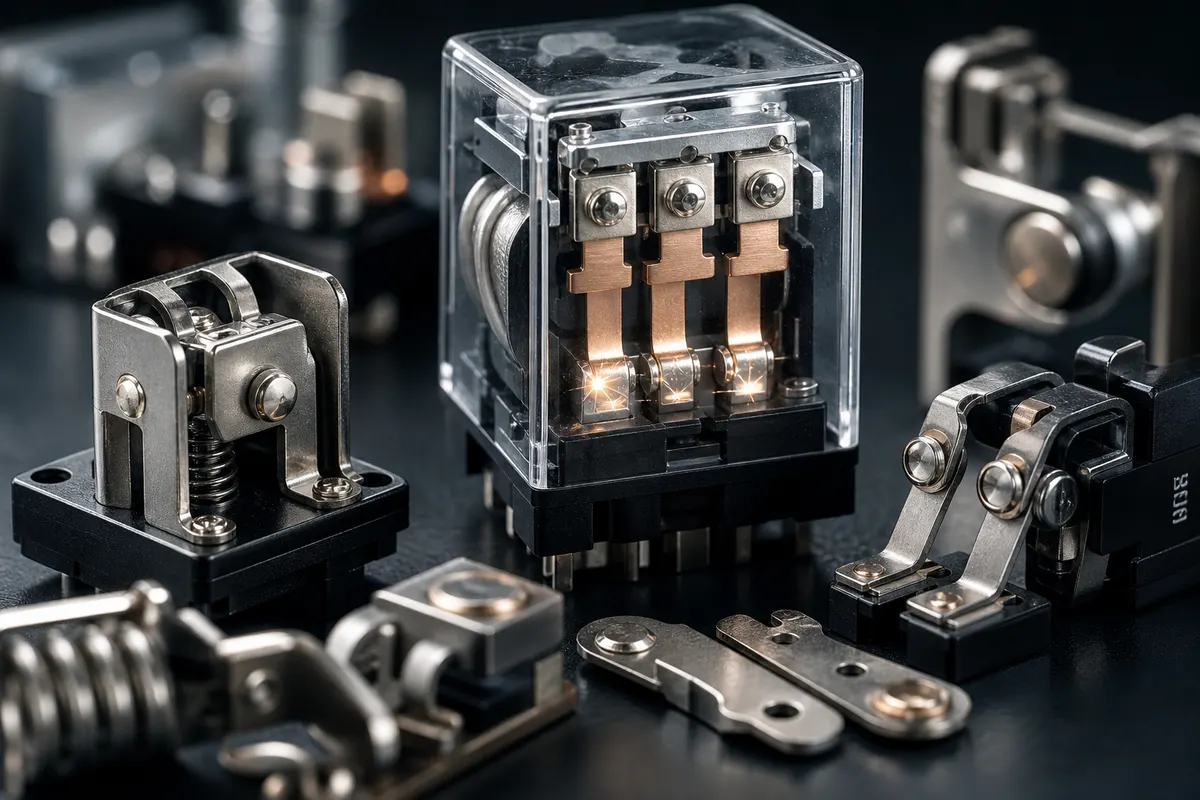
In every electrical device that switches current — from a room light switch to a power plant protection relay — silver in contacts plays a decisive role. A contact is the circuit part that carries current when closed and breaks it when open. This seemingly simple process repeats millions of times under varying current, voltage, and environmental conditions. With superior electrical conductivity and unique oxide behavior, silver has been the industry standard for contacts and switches for decades.
Why Is Silver Chosen for Contacts?
Three properties make silver ideal for contacts: first, electrical conductivity higher than any metal. Second, low contact resistance even after surface wear. Third, silver oxide (Ag₂O), unlike copper or aluminum oxide, remains a suitable electrical conductor and does not cause severe contact resistance increase. This is critical in relays that sit unused for years then must immediately carry heavy current. For very high current applications, silver alloys with metal oxide (AgSnO₂, AgCdO) provide better resistance to electrical arc wear.
Types of Silver Contacts
Contacts take various forms by application. Pure silver contacts are used in signal relays and low-current equipment. Silver-plated contacts on copper or brass bases reduce cost in common household switches. Solid silver contacts serve industrial and medical equipment requiring high reliability. Composite contacts made from silver powder with tin or cadmium oxide resist welding from electrical arcing.
Relays, Contactors, and Power Switches
In industrial electrical panels, protection relays and motor contactors use silver or AgNi (silver-nickel) contacts. When breaking inductive current, an electric arc forms that can melt the contact surface. Silver alloys with dispersed metal oxide reduce this damage.
Silver Plating on Contacts
Not all contacts are made of solid silver. In many cases, the core is brass, phosphor bronze, or beryllium-copper plated with 3 to 20 microns of silver. Plating methods include electroplating, electroless plating, and clad bonding. Plating quality — uniform thickness, adhesion, and purity — depends on silver quality in the electrolyte bath. Bazaarnoghre supplies 999.9 silver for plating plants and contact manufacturers.
Silver in Automotive and Electronic Switches
The automotive industry is one of the largest contact consumers. Steering column switches, fan and heater relays, and BCM systems use silver contacts. With electric vehicle growth, DC fast-charging contacts carrying hundreds of amperes need pure silver or AgSnO₂. In consumer electronics, mechanical keyboard switches and SMD switches also use silver plating.
Contact Material Comparison Table
| Contact Material | Conductivity | Arc Resistance | Cost | Application |
|---|---|---|---|---|
| Pure silver (Ag) | Excellent | Moderate | High | Signal relays, medical equipment |
| AgSnO₂ | Very good | Excellent | High | Power switches, automotive |
| AgCdO | Very good | Excellent | High (environmental limits) | Legacy, being replaced |
| Silver-plated copper | Good | Moderate | Medium | Household switches, electronics |
| Unplated brass | Moderate | Weak | Low | Low-importance applications |
Service Life and Test Standards
Industrial contacts must pass standards such as IEC 60947 (contactors) and UL 508. Mechanical tests include millions of open-close cycles without contact resistance increase beyond allowable limits. Selected silver alloy, contact force, closing speed, and environment (humidity, dust, corrosive gases) affect effective life.
Contact Design and Contact Engineering
Designing a proper contact goes beyond material selection. Contact force, closing speed, surface shape (rounded, flat, multi-point), and operating environment all affect performance. In high-current contacts, uniform pressure distribution prevents local melting. Finite element analysis (FEA) simulation and accelerated life tests are performed before final approval. Engineers typically work closely with silver alloy suppliers to determine the optimal composition for each application.
Maintenance and Inspection of Silver Contacts
Silver contacts in low-duty (standby) equipment may remain motionless for years. In humid, sulfur-rich (H₂S) environments, sulfide layers form on the surface increasing contact resistance. Periodic inspection, contact cleaner treatment, and in severe cases contact replacement are recommended. In industrial electrical panels, silver contacts are part of preventive maintenance (PM) programs.
Silver Supply for Contact Manufacturers
Contact producers need pure silver, silver powder for powder metallurgy, and silver for plating baths. Purity consistency and absence of impurities such as lead, bismuth, and excess copper are critical for plating quality. Bazaarnoghre supplies ../../../index.html#products and technical consultation as a partner for electrical industries. Contact ../../../index.html#contact and read about silver conductivity in ../silver-electrical-conductor/ and electronics applications in ../.
International Contact Standards
Beyond IEC and UL, standards IEC 61810 (relays), IEC 60947-4 (contactors), and SAE (automotive) define precise requirements for silver contacts. Tests include cycle count (e.g., 10 million cycles for signal relays), allowable contact resistance increase (typically under 10 milliohms), and performance from -40 to 85+°C. Contact manufacturers obtain ISO 9001 and IATF 16949 (automotive) certifications to demonstrate quality systems.
History of Silver Contacts
Silver use in electrical contacts dates to the early twentieth century when telephone relays and telegraph equipment needed reliable contact. With urban and industrial electrification expansion, AgCdO and then AgSnO₂ alloys were standardized — the latter replacing the former due to cadmium environmental restrictions. Today in electric vehicles, each car may use 50 to 100 grams of silver in contacts, relays, and charging systems.
Contact Production Process from Silver
Solid silver contacts are made via powder metallurgy (compaction and sintering of silver powder), precision casting (investment casting), or machining from silver sheet. AgSnO₂ composite contacts are produced by mixing silver and tin oxide powder then sintering. Each method has cost and precision trade-offs. Controlled particle size and purity silver powder is the primary raw material.
Common Contact Defects and Solutions
Pitting (local corrosion), welding (contact sticking), and increased contact resistance are common defects. Appropriate alloy selection, sufficient contact force design, and dry environment are preventive solutions. In marine and oil & gas industries, gold-plated contacts on silver bases resist corrosive gases.
Contacts in Energy Equipment and Power Grids
In substations, circuit breakers and high-voltage disconnectors use silver-plated or AgW (silver-tungsten) contacts for thousands-of-ampere currents. In large-scale energy storage (BESS) and solar inverters, DC contacts with high continuous current need silver because switching is less frequent but continuous conduction with minimal loss matters. IEC 62271 standards define contact requirements for high-voltage equipment.
In the global market, companies such as TE Connectivity, Omron, and Schneider Electric produce billions of contacts annually. Their supply chains depend on silver powder and sheet with consistent spec. Any silver supply disruption can halt contact production lines — which is why long-term contracts with suppliers like Bazaarnoghre are strategically important.
Correct alloy selection and silver supplier choice distinguish ordinary equipment from industrially reliable equipment.
Summary: silver in contacts and switches guarantees electrical reliability at every scale — from a small switch to a multi-hundred-ampere industrial contactor.
Further reading
- Electrical contacts — Wikipedia
- International Electrical Contacts Association
- Silver statistics — USGS
Related articles
To view 999.9 fine silver products, visit the Bazaarnoghre products page.